
Written by the Token Tails team. Facts checked against live data on ; sources are listed at the end.
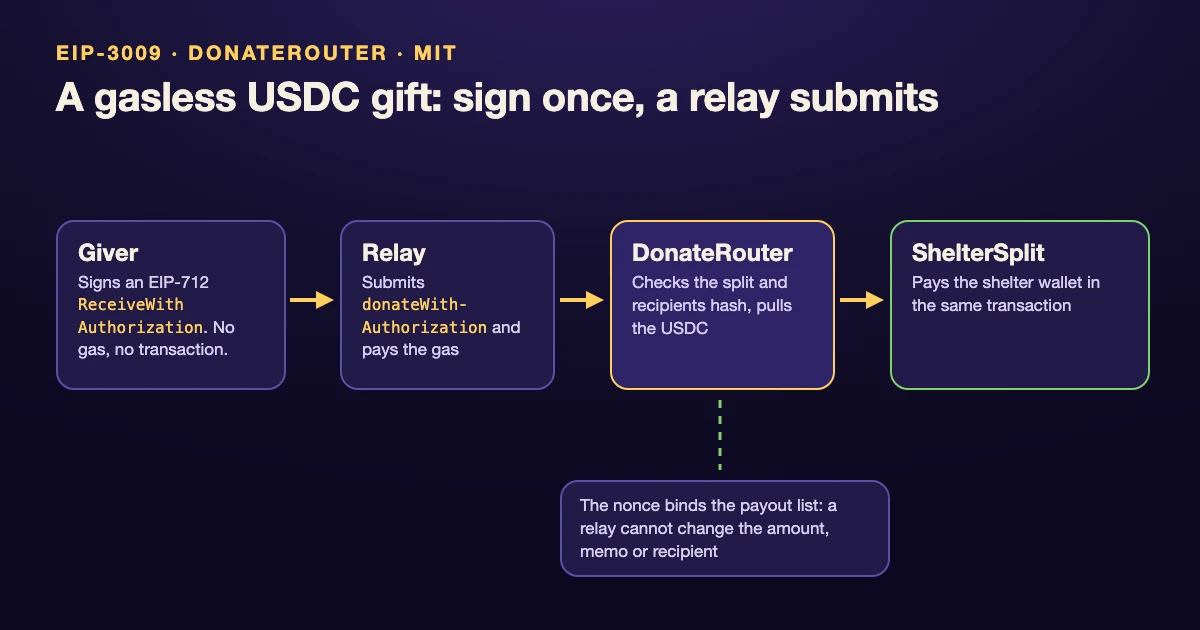
EIP-3009 lets a USDC holder move USDC by signing one EIP-712 message instead of submitting a transaction, so a relay can submit it and cover the gas.
For donations to a contract, use receiveWithAuthorization, not transferWithAuthorization: it only lets the payee contract redeem the signature, which closes a front-running hole.
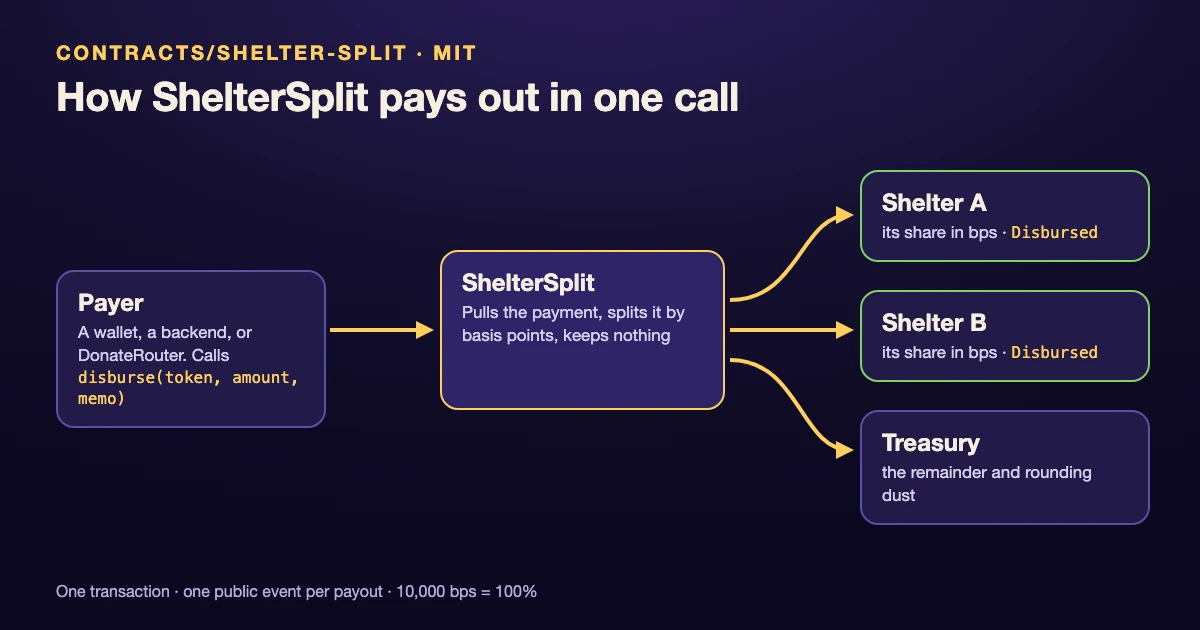
This guide walks through how we use it in DonateRouter, an MIT-licensed contract that passes a USDC gift through to a shelter’s wallet in one transaction. All code is open in contracts/shelter-split. The concepts carry over to any “sign once, a relay submits” flow.
Key takeaways
- The donor signs a
ReceiveWithAuthorizationtyped message; no approve step and no transaction from the donor. receiveWithAuthorizationrequiresmsg.sender == to, so only the payee contract can use the signature.- DonateRouter packs the memo and the exact payout list into the EIP-3009 nonce, so nobody can redirect a signed gift.
- Read
name()andversion()from each USDC contract: Base’s USDC is “USD Coin”, Arc’s and Monad’s are “USDC”. - On Arc, USDC is the native coin with 18 decimals, but its ERC-20 interface uses 6.
EIP-3009 in two minutes
EIP-3009 adds signed transfers to a fungible asset contract. Circle’s USDC (the FiatToken contract) implements it. The holder signs an EIP-712 message with six fields:
| Field | Meaning |
|---|---|
from |
The payer (the signer) |
to |
The payee |
value |
Amount in base units (USDC: 6 decimals) |
validAfter |
Unix time after which it can be used |
validBefore |
Unix time before which it must be used |
nonce |
A random 32-byte value, used once |
Anyone holding the signature can submit it. The USDC contract checks the signature, checks the time window, marks the nonce as used and moves the funds. The signer never touches gas.
Unlike ERC-2612 permit, nonces are random rather than sequential, so a wallet can have many open authorizations at once and none blocks another. authorizationState(authorizer, nonce) tells you whether one has been used, and cancelAuthorization lets the signer kill an unused one.
transferWithAuthorization vs receiveWithAuthorization
Both take the same signed fields. The difference is who may call them.
transferWithAuthorization |
receiveWithAuthorization |
|
|---|---|---|
| Who can submit | Anyone | Only the payee (msg.sender == to) |
| Typed data name | TransferWithAuthorization |
ReceiveWithAuthorization |
| Safe when the payee is a contract | No | Yes |
Here is the problem with the first one. Say a donor signs a transferWithAuthorization whose payee is your gift contract, and your relay submits the contract’s give(signature). A front-runner who sees the signature in the mempool can call USDC’s transferWithAuthorization directly first. The USDC lands in your contract, the nonce is spent, the relay’s give call reverts, and none of your contract’s logic (splitting, events, memo) ran.
With receiveWithAuthorization, USDC only accepts the call from the payee itself, so the signature is useless to anyone but your contract. That is why DonateRouter’s donor signs ReceiveWithAuthorization with to set to the router.
The typed data we sign
The EIP-712 domain is the USDC contract’s own, read from the chain:
{
  "domain": {
    "name": "USDC",
    "version": "2",
    "chainId": 5042,
    "verifyingContract": "0x3600000000000000000000000000000000000000"
  },
  "primaryType": "ReceiveWithAuthorization",
  "types": {
    "ReceiveWithAuthorization": [
      { "name": "from", "type": "address" },
      { "name": "to", "type": "address" },
      { "name": "value", "type": "uint256" },
      { "name": "validAfter", "type": "uint256" },
      { "name": "validBefore", "type": "uint256" },
      { "name": "nonce", "type": "bytes32" }
    ]
  },
  "message": {
    "from": "<donor>",
    "to": "<DonateRouter>",
    "value": "1000000",
    "validAfter": "0",
    "validBefore": "<now + 300>",
    "nonce": "<router.authNonce(salt, memo, recipients)>"
  }
}
The values above are for USDC on Arc mainnet (chain 5042), as read on 19 October 2026. The types also include the standard EIP712Domain entry; value 1000000 is 1 USDC.
The interesting part is the nonce. EIP-3009 only asks for 32 random bytes, so DonateRouter derives them from what the donor means to do:
function authNonce(bytes32 salt, string calldata memo, bytes32 recipients) public view returns (bytes32) {
    return keccak256(abi.encode(address(this), keccak256(bytes(memo)), salt, recipients));
}

function recipientsHash(uint256 amount) public view returns (bytes32) {
    (address[] memory wallets, uint256[] memory amounts,) = split.preview(amount);
    return keccak256(abi.encode(wallets, amounts));
}
salt is fresh randomness from the donor’s client, which keeps every nonce unique. recipients is the hash of every shelter wallet and the exact amount each would receive for this gift, read from ShelterSplit’s preview. Because the nonce is inside the signature, the memo, this router and the payout list are all signed too, without changing EIP-3009 at all.
What the router checks before it pays
When a relay calls donateWithAuthorization(gift, memo, signature), the router runs these checks in order:
- Guard. The amount is not zero, the split is not paused, and
preview(amount)sends nothing to the split’s treasury. - Payout list.
recipientsHash(value)still equals therecipientsthe donor signed. If the split owner changed a shelter wallet in between, the call reverts withRecipientsChangedand the USDC stays with the donor. - Redeem. It recomputes the nonce and calls USDC’s
receiveWithAuthorizationwith itself asto. - Pay out. It approves exactly the amount, calls
ShelterSplit.disburse, and checks that the treasury balance did not move.
The router has no owner, no setters and no sweep, and it never holds a gift between transactions. A bytes signature overload covers FiatToken v2.2, which also accepts ERC-1271 smart and passkey wallets; donateWithAuthorizationVRS covers contracts that only have the v/r/s form.
Relaying: who pays the gas?
Anyone may submit a signed gift and pay its gas: a backend relay, a bot, or the donor’s own second wallet. The relay cannot change the amount, the memo or where the money goes; all it can do is submit or not submit.
Be clear about today’s state: Token Tails’ public gasless relay is not switched on. The live status endpoint, GET https://api.tokentails.com/shelter/match/status, reports "relay": false. The mechanism, the routers and the client code are public, so you can run your own relay against the deployed routers, or test the whole flow on a testnet.
On the client side, the Shelter Rail SDK does the signing in one call. signAndRelay checks that the router points at the expected split and USDC, calls canDonate, reads recipientsHash and authNonce, reads USDC’s name() and version(), asks the wallet for one eth_signTypedData_v4, and POSTs the result to the relay URL you pass in.
Nonces, time windows and replay protection
- Single use. USDC marks each
(from, nonce)pair as used. A second submit reverts. - No cross-chain replay. The domain includes
chainIdand the USDC address, so a signature for Base is invalid on Arc. - Short windows. The SDK sets
validAfterto 0 andvalidBeforeto five minutes from now. A stale signature simply expires. - Cancellation. Before it is used, the signer can cancel an authorization with
cancelAuthorization. - Finding a gift someone else submitted. The router’s
RouterDonationevent indexes the nonce, so a relay can see that a gift already went through.
Testing on Arc testnet
Arc testnet is chain 5042002. Its USDC lives at 0x3600000000000000000000000000000000000000, and the USDC DonateRouter we deployed there is 0xa1cf1db2042dea0f169b1acdab479d4f17852860 (explorer). The full list of routers per network is in routers.json.
- Add Arc testnet to your wallet (Arc docs) and get test USDC from the Circle faucet.
- Call
canDonate(1000000)on the router to confirm it would accept a 1 USDC gift. - Sign and submit with
signAndRelayagainst your own relay, or calldonateWithAuthorizationyourself from a second account to play the relay. - Look for the
RouterDonationevent and the ShelterSplit payout events in the same transaction.
The Foundry suite covers the router with unit, invariant and fork tests (test/DonateRouter*.t.sol). Run forge test inside contracts/shelter-split.
Pitfalls we hit
- Do not hardcode the domain. Read
name()andversion()from the USDC contract. On 19 October 2026 Base’s USDC returned “USD Coin” and Arc’s and Monad’s returned “USDC”, all with version “2”. A wrong name gives a valid-looking signature that fails on chain. - Decimals on Arc. USDC is Arc’s native gas coin with 18 decimals, while its ERC-20 interface uses 6. EIP-3009 goes through the ERC-20 interface, so 1 USDC is
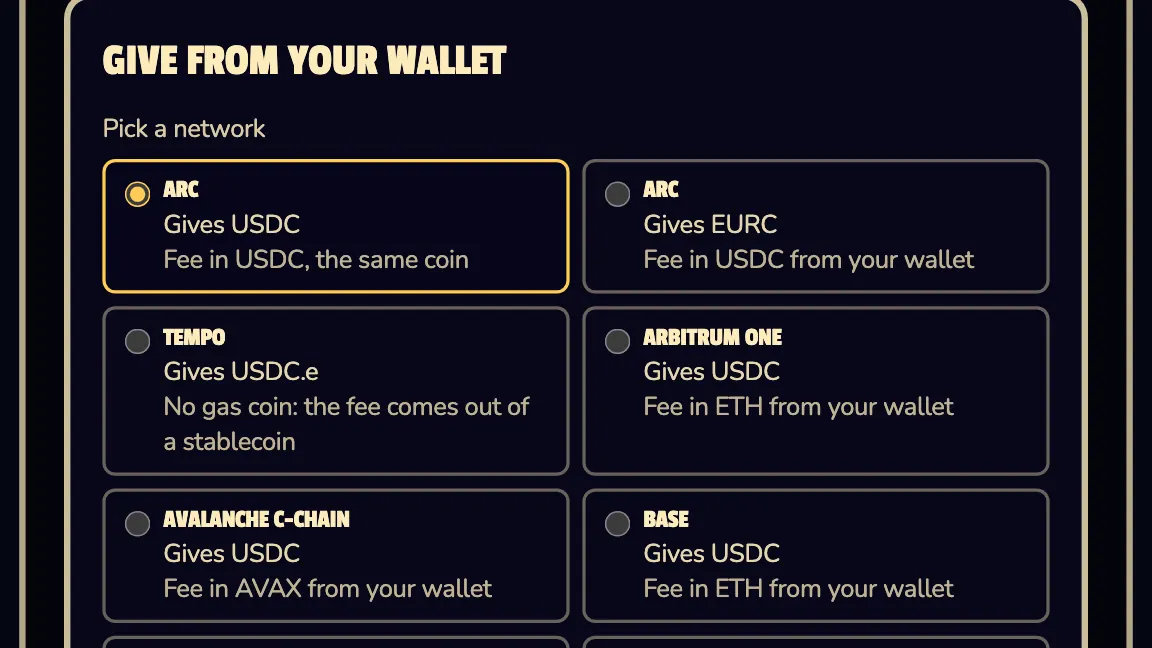
1000000. NativedonateNativegifts use 18-decimal units. - Not every stablecoin has EIP-3009. Tempo’s TIP-20 coins and USDG on Robinhood Chain do not, so those networks have a ShelterSplit but no router; gifts there use approve plus
disburse. - Memo limits. Memos are at most 256 bytes. A memo on the
flushpath is untrusted: whoever calls first sets it. - Recipients drift. If the payout list changes between signing and submitting, the gift reverts. That is the point, but your UI should re-sign rather than retry.
Where to go next
- Read the contracts and tests: contracts/shelter-split (MIT).
- Use the SDK or drop-in widget: shelter-rail (MIT).
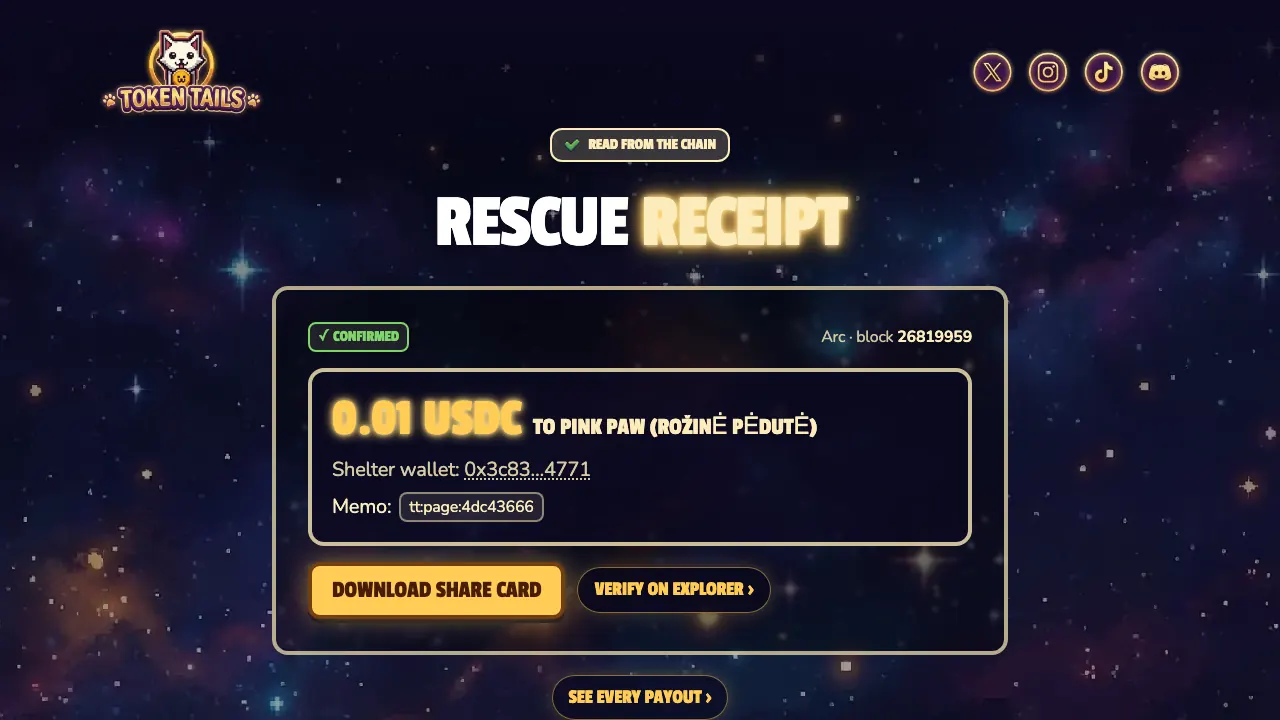
- See real payouts with their transactions: /shelter-payouts.
- Learn the split itself: USDC payment splitter contract, and the network we started on: USDC payouts on Arc.
- Put a gift button on a page: crypto donation button for any website. Let an AI agent pay over HTTP: x402 donations.
Frequently asked questions
What is EIP-3009?
A standard for transferring a fungible asset with a signed authorization instead of a transaction from the holder. USDC implements it, so a holder can sign an EIP-712 message and anyone can submit it on chain.
What is the difference between transferWithAuthorization and receiveWithAuthorization?
Anyone can submit a transferWithAuthorization. receiveWithAuthorization adds one rule: the caller must be the payee. When the payee is a contract, that stops a front-runner from redeeming the signature outside the contract's own logic.
Who pays the gas in an EIP-3009 transfer?
Whoever submits the signed authorization, usually a relay. The signer pays nothing in gas and sends no transaction.
Can a relay change the amount or the recipient?
No. The amount, the payee and the validity window are inside the signature. In DonateRouter the memo and the exact shelter payout list are bound into the nonce too.
Check it yourself
Facts checked against live data on . Live figures change: the links below always show the current ones.
- EIP-3009: Transfer With Authorization(opens in a new tab)
- DonateRouter source (MIT)(opens in a new tab)
- ShelterSplit and DonateRouter README(opens in a new tab)
- Shelter Rail SDK and widget (MIT)(opens in a new tab)
- Arc docs: connect to Arc(opens in a new tab)
- Circle faucet(opens in a new tab)
- Every payout for Pink Paw, with its transaction
- Impact: totals with dates and sources