
Written by the Token Tails team. Facts checked against live data on ; sources are listed at the end.
To help a stray cat, first find out whether it is lost, then get it a microchip scan, give it water, food and a dry place, and link up with a local trap-neuter-return (TNR) group or shelter. If you cannot help in person, supporting the people who already do this work is the next best thing.
This guide covers both: what to do with the cat in front of you, and how to help from home.
Key takeaways
- Watch first. Friendly strays may be someone’s lost pet; feral cats need a different approach.
- A vet or shelter can scan for a microchip; it is quick and often free.
- An ear tip means the cat is already sterilised and part of a TNR programme.
- Trap-neuter-return, run by local groups, is how outdoor cat numbers are brought down humanely.
- From home: volunteer, share, or give to a shelter such as Pink Paw in Kaunas, Lithuania.
First, is it a stray, a lost pet or a feral cat?
Not every cat outside needs rescuing. Many are owned cats that roam, and some are community cats that already have a caretaker. The ASPCA uses “community cats” for outdoor, unowned, free-roaming cats, which may be friendly or feral (ASPCA).
Watch from a distance before you act:
- Friendly or lost: comes towards people, meows, may look clean and well fed. It may simply be lost.
- Feral: keeps its distance or hides, and will not let you near. Feral cats are not socialised to people and usually do badly indoors.
- Ear-tipped: a straight cut across the top of one ear is the usual sign that a cat has been sterilised through a TNR programme. Leave it be.
Approach a friendly cat slowly, crouch, and let it come to you. PetMD advises against grabbing or picking up a stray; use a carrier or a humane trap baited with food instead (PetMD).
Check for a microchip and look for the family
A collar with a tag is the quickest way home. If there is none, take the cat to a vet, shelter or animal control to scan for a microchip; it is quick and often free. Alley Cat Allies asks vets and shelters to scan every cat that comes in (Alley Cat Allies).
At the same time:
- Post a clear photo, the street and the date in local lost-and-found groups and neighbourhood apps.
- Check lost-pet posts and the local shelter’s found list.
- Ask neighbours; someone may already be feeding the cat.
Food, water and shelter, especially in cold weather
A hungry cat will take fresh water and a small meal of cat food. Skip milk, which upsets many cats’ stomachs, and never feed cooked bones or onion-heavy leftovers.
In cold or wet weather, a dry place matters as much as food:
- A plastic storage box with a cat-sized door cut in one side, raised off the ground, makes a simple shelter.
- Line it with straw, not blankets or towels. Fabric soaks up moisture and freezes; straw stays dry.
- Put food and water near the shelter but not inside it, and check the water does not freeze.
If you take a friendly cat in temporarily, give it a quiet room with food, water, a litter box placed away from the food, and somewhere to hide.
Trap-neuter-return, explained
Trap-neuter-return (TNR) is the humane way to bring outdoor cat numbers down over time. Cats are humanely trapped, sterilised and vaccinated by a vet, ear-tipped, and returned to where they live, with a caretaker who feeds and watches them. The ASPCA calls TNR, with ongoing monitoring, “the most humane, efficient way of stabilizing community cat populations” (ASPCA).
You do not have to do it alone. Search for TNR or community cat groups in your town, or ask your local shelter or vet. Many lend traps, run low-cost sterilisation days, or send volunteers to help trap.
Contact a local shelter or rescue
If the cat is injured, sick, a very young kitten, or clearly lost, call a local shelter or rescue for advice before you do anything else. They know local rules and resources, and they decide how to care for and rehome the cats in their care.
Kittens are a special case: a mother cat is often nearby, out finding food. Watch from a distance for a few hours before moving them, unless they are in danger.
Helping stray cats from home
Most people cannot trap a colony or foster a litter. You can still make a real difference by supporting the people who do.
- Give to a shelter or TNR group. Money pays for sterilisation, vet bills and food, and the shelter spends it where the need is. See what cat shelters need and how to donate to a cat shelter online.
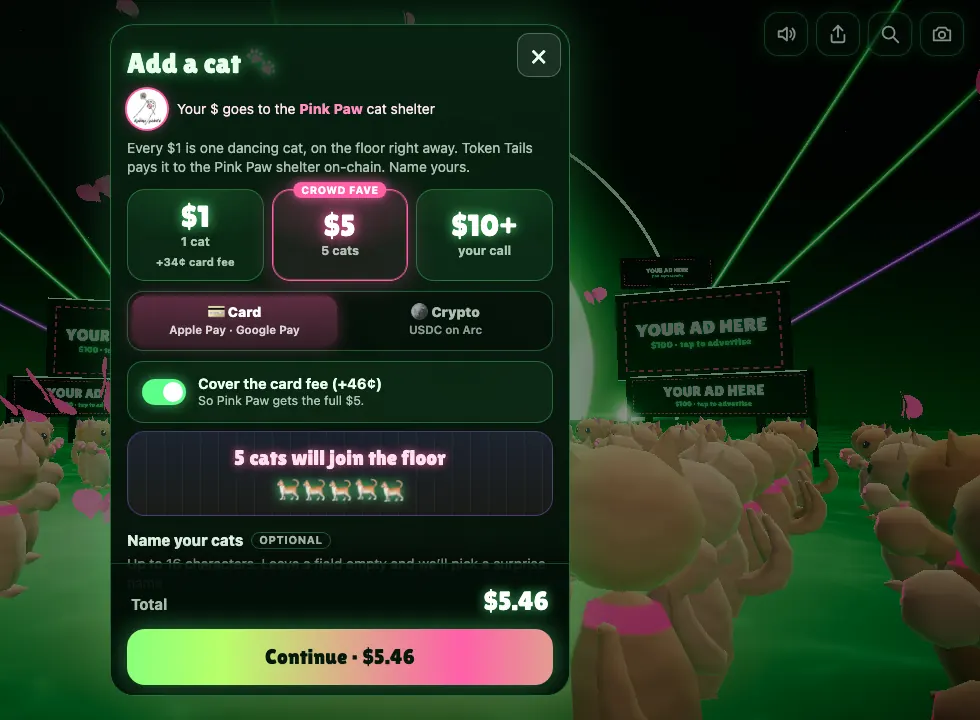
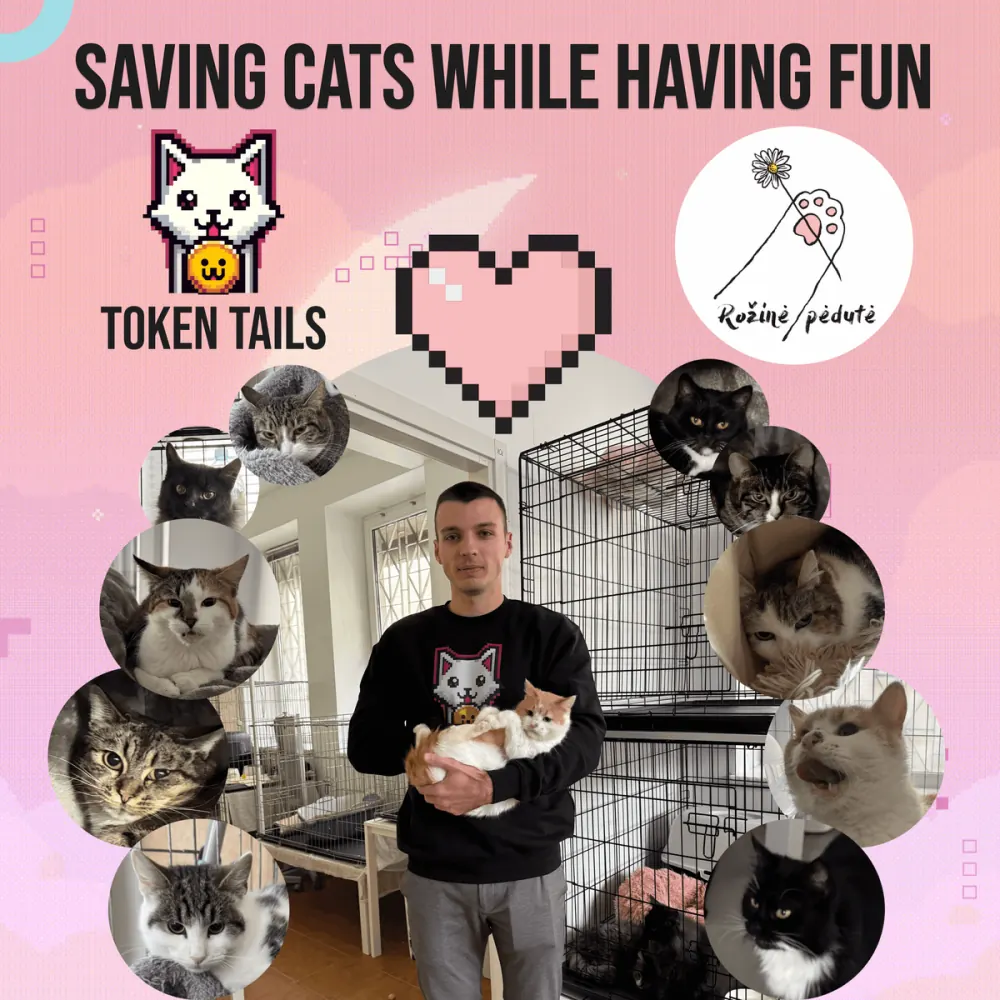
- Give to a shelter in another country. Pink Paw (Rožinė pėdutė) is a cat shelter in Kaunas, Lithuania. On Moon Rave, anyone can add a dancing cat for $1, by card or in USDC on Arc, and the full $1 goes to Pink Paw.
- Play for free. In Catnip Heist, a free stealth game in your browser, you can tap after a win and Token Tails sends Pink Paw a 0.01 USDC treat on-chain (one treat per player per UTC day). It costs you nothing: Token Tails covers the treat.
- Share and volunteer. Sharing a shelter’s posts, driving a cat to the vet, or giving a few hours a month all count.
Every payout to Pink Paw is listed with its transaction on the public shelter payouts page, so you can check where the money went.
What not to do
- Do not grab or chase a cat. You risk bites and scratches, and a frightened cat may bolt into traffic.
- Do not take a feral cat home as a pet. It is stressful for the cat and rarely works; TNR is the better path.
- Do not drop a healthy outdoor cat at a shelter without calling first. Many cats are stressed by shelters, and a cat with a caretaker is often best left where it is.
- Do not move kittens straight away unless they are in danger; the mother is usually close.
- Do not trust viral numbers. Claims about how many kittens one cat “produces” are often wildly exaggerated. Ask a local vet or TNR group what is happening in your area.
Frequently asked questions
What should I do first if I find a stray cat?
Watch from a distance to see if it is friendly or feral, check for a collar or ear tip, then take a friendly cat to a vet or shelter for a microchip scan so its family can be found.
What does a clipped ear on a cat mean?
A straight cut across the tip of one ear usually means the cat has been through a trap-neuter-return programme: it is already sterilised and has someone looking out for it.
Should I feed a stray cat?
Fresh water and a small meal help a hungry cat, but check first that it is not someone's pet, and coordinate with any local caretaker so the cat is not overfed or fed in a way that draws trouble.
How can I help stray cats if I cannot take one in?
Support the people already doing the work: volunteer or give to a local rescue or TNR group, share their posts, or give online to a shelter such as Pink Paw in Kaunas, Lithuania.
Check it yourself
Facts checked against live data on . Live figures change: the links below always show the current ones.
- ASPCA: A closer look at community cats(opens in a new tab)
- PetMD: What to do if you find a stray cat(opens in a new tab)
- Alley Cat Allies: Plan to Scan (microchips)(opens in a new tab)
- Token Tails shelter payouts (live)
- Impact: totals with dates and sources
- The open-source payout contracts (MIT)(opens in a new tab)