
Written by the Token Tails team. Facts checked against live data on ; sources are listed at the end.
To foster a cat, you contact a shelter or rescue that runs a foster programme, apply, and then care for one of its cats in your home until the cat finds a permanent home. The shelter usually covers food and vet care; you give a quiet room, daily care, time and patience.
Fostering frees a space in the shelter for the next cat and gives a cat a calmer place to recover, grow up or show its real personality. This guide covers what foster carers do, who can foster, what you need at home and how to start.
Key takeaways
- A foster carer looks after a shelter’s cat at home for a while; the shelter still owns the cat and finds it a home.
- Big organisations usually cover food, supplies and vet care: the ASPCA calls fostering with it “completely free”.
- You will need a separate, cat-safe room, plus time each day; kittens need more.
- Your own pets stay apart from the foster cat, at least at first.
- Requirements vary by shelter: the ASPCA and the RSPCA both ask that you are 18 or over.
What a foster carer does
“Animal fostering is when a person temporarily cares for a shelter animal in their home,” the ASPCA explains, with the aim of providing “a safe, comfortable and loving environment” while the animal gets ready for a new home (ASPCA).
Day to day, that usually means:
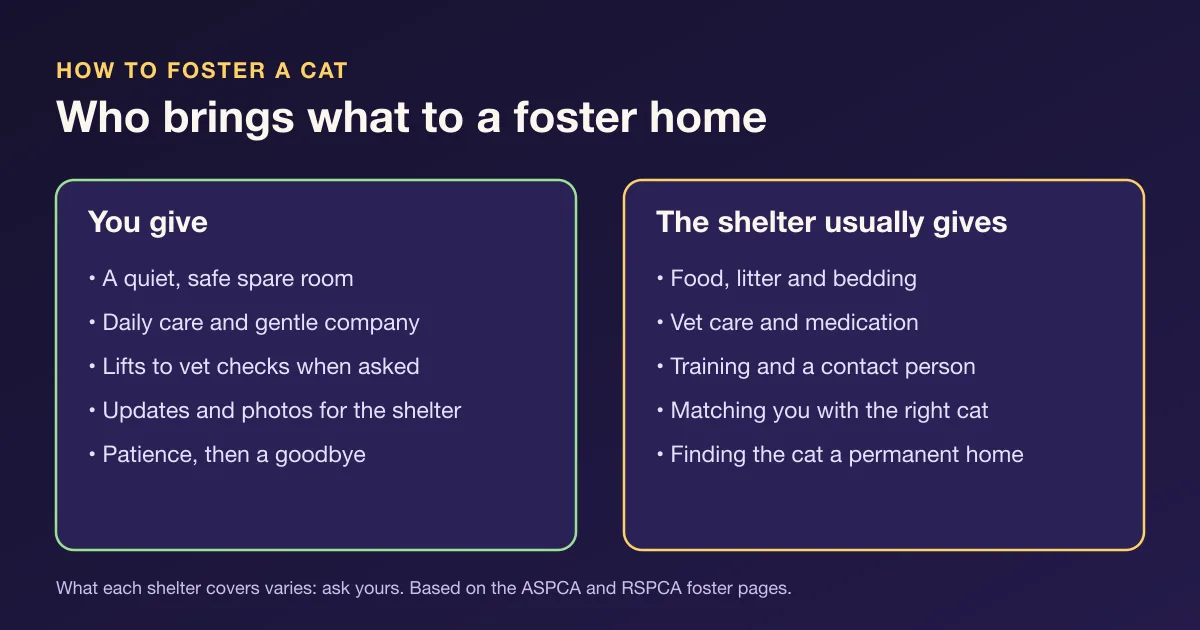
- feeding, cleaning the litter tray and keeping the room clean
- spending time with the cat so it gets used to people and household life
- watching for health problems and reporting them to the shelter
- bringing the cat in for vet checks, vaccinations or sterilisation when asked
- sending updates, photos and notes on personality, which help the shelter find the right home
The shelter stays responsible for the cat. It decides on vet care and handles rehoming.
Who can foster a cat?
Every organisation sets its own rules. Two large examples:
| ASPCA (US) | RSPCA (England and Wales) | |
|---|---|---|
| Age | 18 or over | 18 or over |
| Where you live | Near one of its shelters | Flats and rented homes can work, with the landlord’s permission; no garden needed |
| Other pets or children | Your pets must be healthy and vaccinated (ASPCApro guide) | Possible, assessed for each cat |
| How to start | Foster application or information session | Register as a volunteer, apply, home assessment, training |
Sources: ASPCA, ASPCApro foster guide, RSPCA.
The ASPCApro feline foster care guide, taken from the ASPCA’s Los Angeles foster programme, also asks carers to commit to the whole foster period, keep in touch with the foster team, bring the animal in for follow-up vaccinations and surgery roughly every two weeks, and, for kittens, try to spend at least two hours a day with them (ASPCApro).
Smaller rescues may be more flexible, or more strict. Ask.
What you need at home
A separate room. New places are stressful for most cats, and many hide at first. The ASPCApro guide suggests a “safe haven” such as a roomy crate or a spare room; a spare bathroom is ideal because it has no hiding spaces and is easy to disinfect (ASPCApro). The RSPCA asks carers to keep foster cats indoors while they settle (RSPCA).
The basics. The ASPCApro guide’s list, some of which the shelter will provide (ASPCApro):
- litter tray and litter
- a carrier (with the door off, it doubles as a hiding place)
- wet and dry food suited to the cat’s age
- food and water bowls
- washable bedding, kept clean and dry
- scratch pads and easy-to-clean toys
- treats
- disinfectant
Extras for young kittens. Formula, a syringe and bottle, a heat source and kitchen scales for the youngest kittens. Kittens under five weeks may not be able to regulate their body temperature, so they may need a heat source, with an unheated area they can move to if they get too hot (ASPCApro). Bottle-feeding is a skill: the shelter should train you before you take on very young kittens.
A cat-safe room. Remove string, elastic bands, pins and small objects; keep toilet lids down; secure window screens and cords; take out plants and flowers, as many are toxic to cats; keep cleaning products out of reach; and never give human food (ASPCApro).
What the shelter usually provides
This is where fostering differs from taking a cat home for good. With large organisations, the costs mostly sit with the shelter:
- ASPCA: “Being a foster caregiver is completely free.” It provides food, supplies (bowls, collars, medications) and vet care, plus support (ASPCA).
- RSPCA: typically covers food and basic supplies, litter and bedding, and “normally covers veterinary care,” with a coordinator to contact and behaviour guidance (RSPCA).
Small rescues run on tight budgets and may ask you to cover some food or litter. Agree on who pays for what, and who to call in an emergency, before the cat arrives.
Kittens, adults, seniors and medical fosters
Foster homes are needed for very different cats:
- Kittens, with or without their mother. Often the most time-consuming. Very young orphaned kittens need bottle-feeding round the clock; the ASPCApro guide says kittens under two weeks are fed every 3 to 4 hours.
- Shy or stressed adults. The RSPCA fosters cats stressed by the shelter environment or recovering from neglect. A quiet home often shows who they really are.
- Medical fosters. Cats recovering from illness or surgery, or kittens going through treatment such as for ringworm, which the ASPCA trains some fosters for.
- Cats waiting for a home. Some placements simply move a cat from a kennel to a sofa while the shelter looks for its family.
Sources: ASPCA, RSPCA, ASPCApro.
Tell the shelter honestly how much time you have. A busy household might suit a confident adult cat better than a litter of six-week-old kittens.
Keeping your own pets safe
Foster cats can carry infections that your own pets can catch, and the other way round. The ASPCApro guide asks carers to:
- keep foster cats separate from resident animals in their own room
- quarantine new foster animals for 14 days before any introductions
- make sure resident animals are healthy and up to date on vaccines
- wash hands thoroughly after contact with the foster cat, especially between handling it and your own pets, and keep the foster room’s supplies dedicated to it and easy to clean
Source: ASPCApro.
If your foster cat shows signs such as lethargy, diarrhoea, loss of appetite, sneezing or runny eyes, or visible parasites, keep it apart and call the shelter. Ask your vet about your own pets’ vaccinations and health before you start fostering, and follow the shelter’s vet advice for the foster cat.
The first days with a foster cat
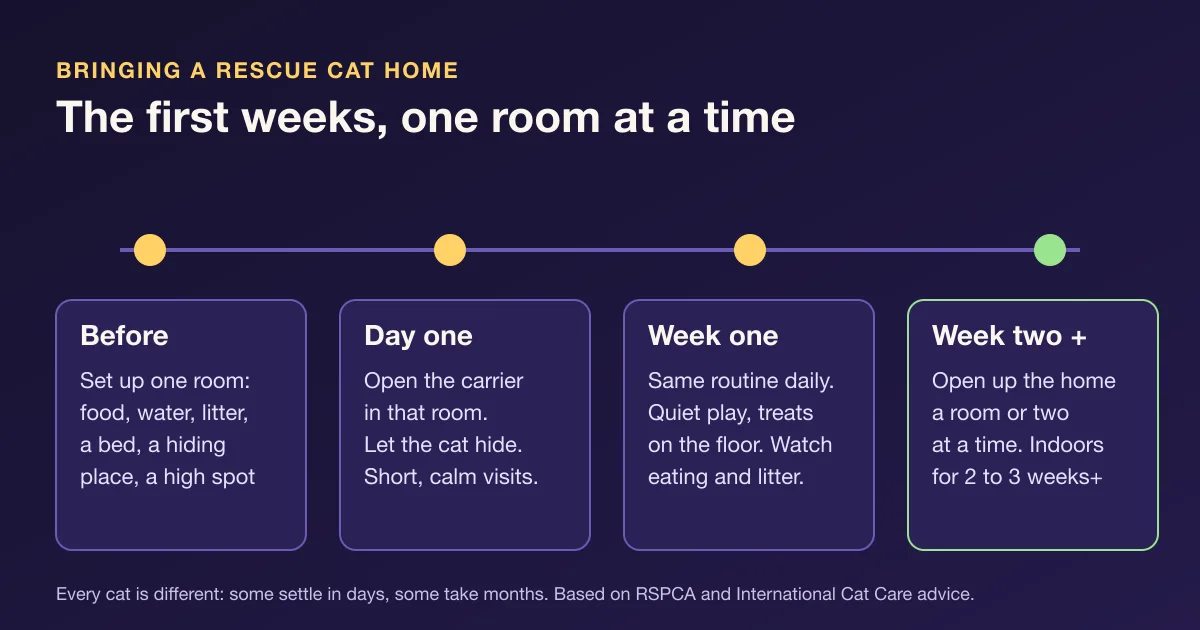
Open the carrier in the foster room and let the cat decide when to come out. “Never try to pull your new foster cat out of hiding,” the ASPCApro guide says; sit in the room, read aloud so the cat learns your voice, and offer treats (ASPCApro). International Cat Care gives the same advice for any new cat: don’t coax a hiding cat out, and let it come to you when it is ready (iCatCare).
A cat that eats, drinks, uses the litter tray and moves around calmly is settling in. Some take less than a day, others weeks. If there is no progress after a week, tell the shelter. Much of this is the same as for any new cat; see bringing a rescue cat home for a week-by-week guide.
Saying goodbye
The hardest part of fostering is the end. The ASPCApro guide reminds carers that every family member should be ready for “the commitment and emotions involved with fostering.”
A few things help:
- Remember that the goodbye is the goal: the cat is going to a home of its own, and your space is free for the next one.
- Write a short note for the new family about the cat’s habits, favourite toys and food.
- Ask the shelter whether the new family is happy to send an update.
Some carers fall for a foster cat and want to keep it. Ask your shelter how that works; it usually goes through the shelter’s normal rehoming process. Fostering works best when you go in planning to let go.
How to start fostering
- Find local shelters and rescues and check their websites for a foster page, or call them.
- Ask the key questions: what they cover, how long placements usually last, what training they give and who to call out of hours.
- Apply, and expect a home check, in person or by video.
- Prepare the foster room before your first cat arrives.
- Start small if you can, with a healthy adult cat, before you take on bottle-fed kittens.
If you live near Kaunas, Lithuania, Pink Paw (Rožinė pėdutė), the cat shelter our games are built around, is one place to ask; read more about Pink Paw. Wherever you are, your nearest shelter is the best place to start.
Not ready to foster?
Fostering is a big commitment, and it is fine if now is not the right time. Shelters need help in other ways too, from sharing their posts to giving the supplies on their wish list. See free ways to help animal shelters and what cat shelters need, or how to help stray cats in your area.
You can also help a shelter from your sofa. In Catnip Heist, a free browser game, two cats sneak past guard dogs to free a captive cat. After a win, one tap and Token Tails sends Pink Paw a small treat, and it costs you nothing.
Frequently asked questions
How long does fostering a cat last?
It depends on the cat. The RSPCA says placements run from a few weeks to several months, depending on the cat's needs. In the ASPCApro foster guide, kittens are ready for surgery and rehoming at about 8 weeks and 2 pounds (about 0.9 kg).
Does fostering a cat cost money?
Usually not much. The ASPCA says fostering with it is completely free, with food, supplies and vet care provided, and the RSPCA normally covers food, litter, bedding and vet care. Check exactly what your shelter covers before you start.
Can I foster if I already have a cat?
Often yes, but your pets must be healthy and up to date on vaccines, and the foster cat lives in a separate room at first. The ASPCApro foster guide asks for a 14-day quarantine before any introductions. Ask your vet about your own cat's health.
Do I need a garden or a house to foster?
Not necessarily. The RSPCA says no secure garden is needed and that people can foster in flats and rented homes, with the landlord's permission, depending on the cat.
Check it yourself
Facts checked against live data on . Live figures change: the links below always show the current ones.
- ASPCA: What does it mean to be an animal foster caregiver?(opens in a new tab)
- ASPCApro: Feline foster care guide (PDF)(opens in a new tab)
- RSPCA: Foster a cat(opens in a new tab)
- International Cat Care: Helping your new cat or kitten settle in(opens in a new tab)
- Every payout for Pink Paw, with its transaction
- Impact: totals with dates and sources
- The open-source payout contracts (MIT)(opens in a new tab)