
Written by the Token Tails team. Facts checked against live data on ; sources are listed at the end.
Indoor cats still need to hunt, climb, scratch, hide and explore; enrichment simply means giving each of those a safe outlet at home. The best ideas are cheap: short play sessions that end in a catch, food your cat has to find, high places to sit, boxes to hide in and a sturdy scratching post.
Below are 15 ideas grouped by the need they meet, with what cat welfare groups actually recommend, the signs your cat wants more, and when to ask your vet.
Key takeaways
- Play like a hunt: short, frequent sessions with a wand toy, ending in a catch.
- Make food a puzzle: puzzle feeders, scattered kibble or a DIY egg-box feeder.
- Go up: shelves, cat trees and window perches help cats feel safe.
- Give hiding places and tall, sturdy scratching posts near where your cat sleeps.
- Rotate toys so they stay new; watch for stress signs and ask your vet about sudden changes.
Why indoor cats need enrichment
A cat that lives only indoors misses the stalking, chasing, climbing and patrolling an outdoor cat does every day. FECAVA, the federation of European companion animal vets, notes that cats living strictly indoors “can get bored and consequently even develop some related health issues” (FECAVA).
International Cat Care breaks the hunt into steps: searching, locating prey, approach, capture, kill, manipulation and eating (iCatCare). The ideas below give your cat a way to run through those steps without a single bird or mouse involved.
Play like a hunt
1. Wand toy sessions. A wand toy with feathers or fabric on the end lets your cat stalk, chase and pounce while you stay at a safe distance. Move it like prey: hide it behind a chair, let it dart and pause. International Cat Care calls cats “sprinters rather than marathon runners,” so “one minute of frenzied activity is a good result” (iCatCare).
2. Short and often beats long and rare. “Short, frequent play sessions most closely resemble a cat’s natural predatory pattern” (iCatCare). A few quick games spread through the day work better than one long session.
3. Always end with a catch. Let your cat grab the toy at the end, then offer a treat or a meal. A laser pointer is fine for stalking and chasing, but your cat can never catch the dot; International Cat Care suggests switching to a wand toy to finish so the game “ends on a positive note” (iCatCare). Best Friends adds: keep the laser out of your cat’s eyes (Best Friends).
4. Put string toys away afterwards. Best Friends notes that toys with long strings, which includes many wand toys, “should be used only with supervision” (Best Friends). Store them out of reach when the game ends.
Make food a puzzle
5. Puzzle feeders. “Cats in the wild spend up to half of their day looking for, catching and eating prey,” International Cat Care points out, while a bowl twice a day takes seconds (iCatCare). A puzzle feeder makes your cat work a little for part of the daily food. Start with an easy one so your cat succeeds.
6. DIY egg-box or toilet-roll feeders. Drop a few pieces of dry food into the cups of a cardboard egg box, or into toilet-roll tubes folded at the ends. Free, and easy to make harder over time.
7. Scatter feeding. Best Friends suggests tossing kibble on the floor, or hiding small piles of it around the house, so your cat searches for its meal (Best Friends). Take it out of the day’s food allowance rather than adding extra, and if your cat is on a special diet, ask your vet first.
Go vertical
8. Shelves and cat trees. “Cats are natural climbers, and need to be able to rest and watch over their surroundings from high places, as this is where they feel safe” (iCatCare). Wall shelves, a tall cat tree or a cleared bookcase shelf all work. Give shelves a non-slip surface; bare wood is slippery.
9. Window perches. A perch, shelf or cat tree by a window turns the street or garden into daily entertainment. Best Friends suggests adding a bird feeder outside the window where your cat can see it (Best Friends). A full-length window can also bring your cat face to face with a neighbourhood cat; if that unsettles yours, International Cat Care suggests decorative static film on the lower part of the glass, plus a high perch nearby to watch from (iCatCare).
Give them places to hide
10. Boxes and covered beds. “Taking time out from social demands is an essential part of everyday life for a cat, so secret hideaways are important” (iCatCare). A cardboard box on its side, a covered bed, space under a bed or a cleared cupboard all count. Never pull a cat out of its hiding place.
11. Paper and tunnels. A paper bag (handles cut off), a crinkle tunnel or a box with two holes doubles as a hideout and an ambush spot for play.
Scratching in the right places
12. A tall, sturdy post near the bed. Scratching keeps claws in shape and marks territory. International Cat Care advises a post as tall as your cat at full stretch on its hind legs, with a heavy base so it does not wobble, placed where your cat spends time; “as cats often scratch after sleep, it may help to place the post near their favourite bed” (iCatCare).
13. Offer different textures. Sisal, bark and corrugated cardboard each suit different cats, and kittens or senior cats may prefer softer, angled or flat cardboard scratchers. In homes with several cats, International Cat Care recommends one post per cat plus one extra for choice, in different places (iCatCare).
Keep it new: toys, smells and sounds
14. Rotate toys. “Have two or three on the go and rotate them regularly, giving your cat one at a time, to maintain their novelty” (iCatCare). Put the rest away in a drawer; a toy that has been gone for a week feels new again.
15. New smells and cheap surprises. Catnip toys, wheat grass to chew, cardboard boxes, ping-pong balls and wadded-up paper are all on Best Friends’ list of ideas (Best Friends). Catnip appeals to “most (but not all) cats”, so do not worry if yours ignores it (iCatCare).
Signs of a bored cat, and when to ask your vet
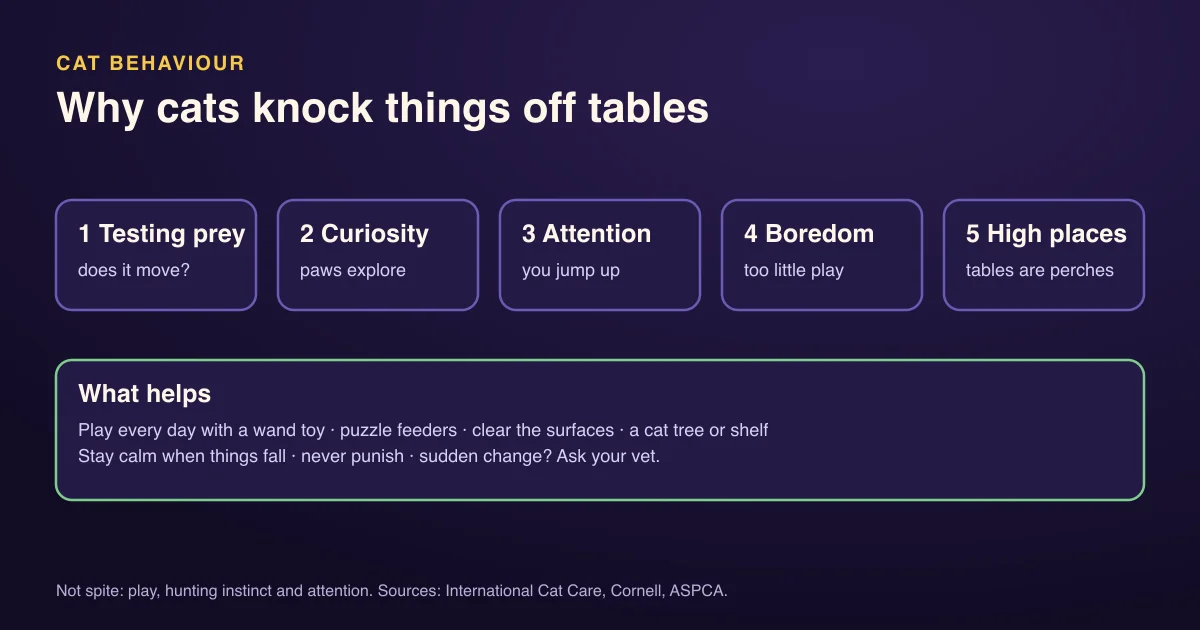
A cat without enough to do often finds its own entertainment. Night-time zoomies, pouncing on ankles and pushing things off shelves can all be part of normal cat behaviour, and enrichment often helps. If your cat has a habit of sweeping pens and mugs off the table, our guide to why cats knock things off tables looks at the reasons.
Some changes are about stress or health rather than boredom. International Cat Care lists these among the signs of stress (iCatCare):
- hiding
- over-grooming
- not eating, or over-eating
- not grooming, or not passing urine or faeces as normal
- becoming reactive towards people or other cats
Any of these can also be a sign of illness or pain. If you notice a sudden change, ask your vet before trying to fix it with toys.
How shelters use enrichment for cats waiting for homes
A new place is stressful for most cats, and a shelter is full of new smells, sounds and other animals. International Cat Care’s guidance for shelter and clinic pens uses the same ideas on a smaller scale: hiding places that give cats “a perceived sense of safety,” shelves and ramps so cats can choose where to rest, scratching posts and perches, low noise and predictable routines for cleaning and feeding (iCatCare).
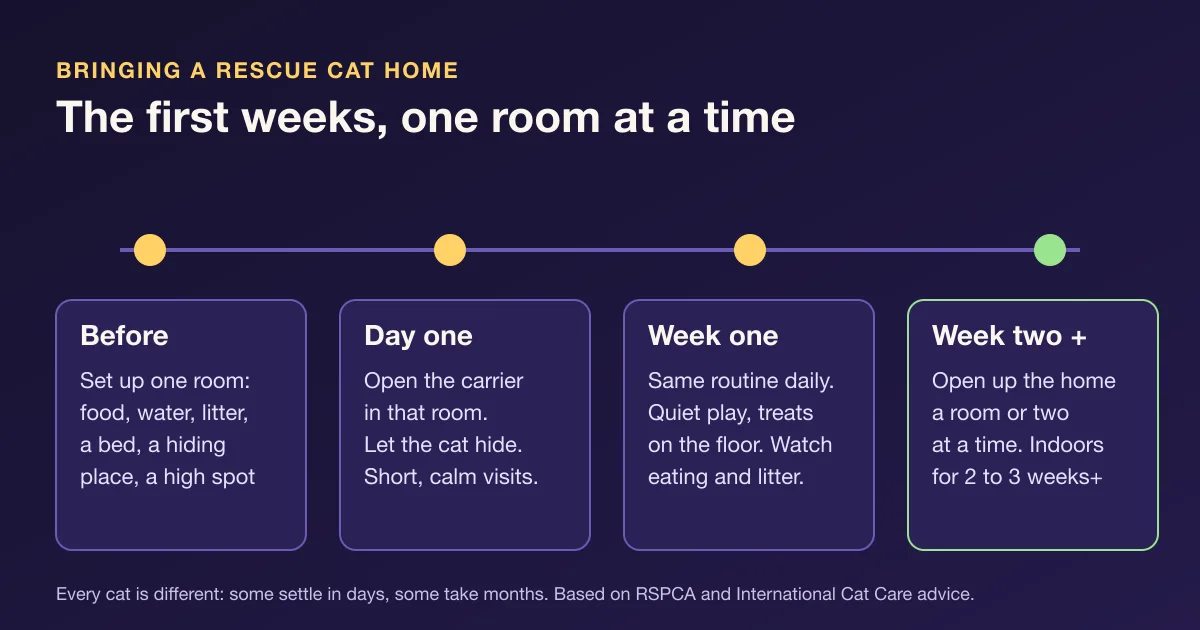
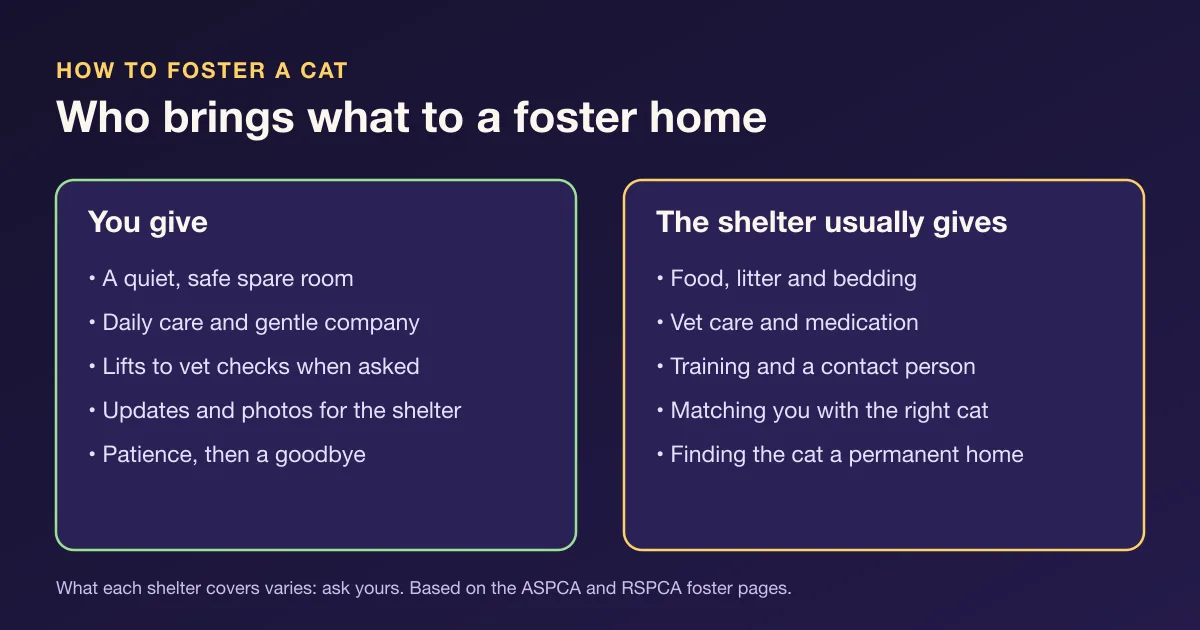
That makes simple toys and scratchers a common item on shelter wish lists, but every shelter has its own rules about what it can accept and clean. Ask first, and see what cat shelters need for the usual list. If you have just brought a cat home from a shelter, our guide to bringing a rescue cat home covers the first two weeks, when a quiet room matters more than new toys.
Enrichment for you, too
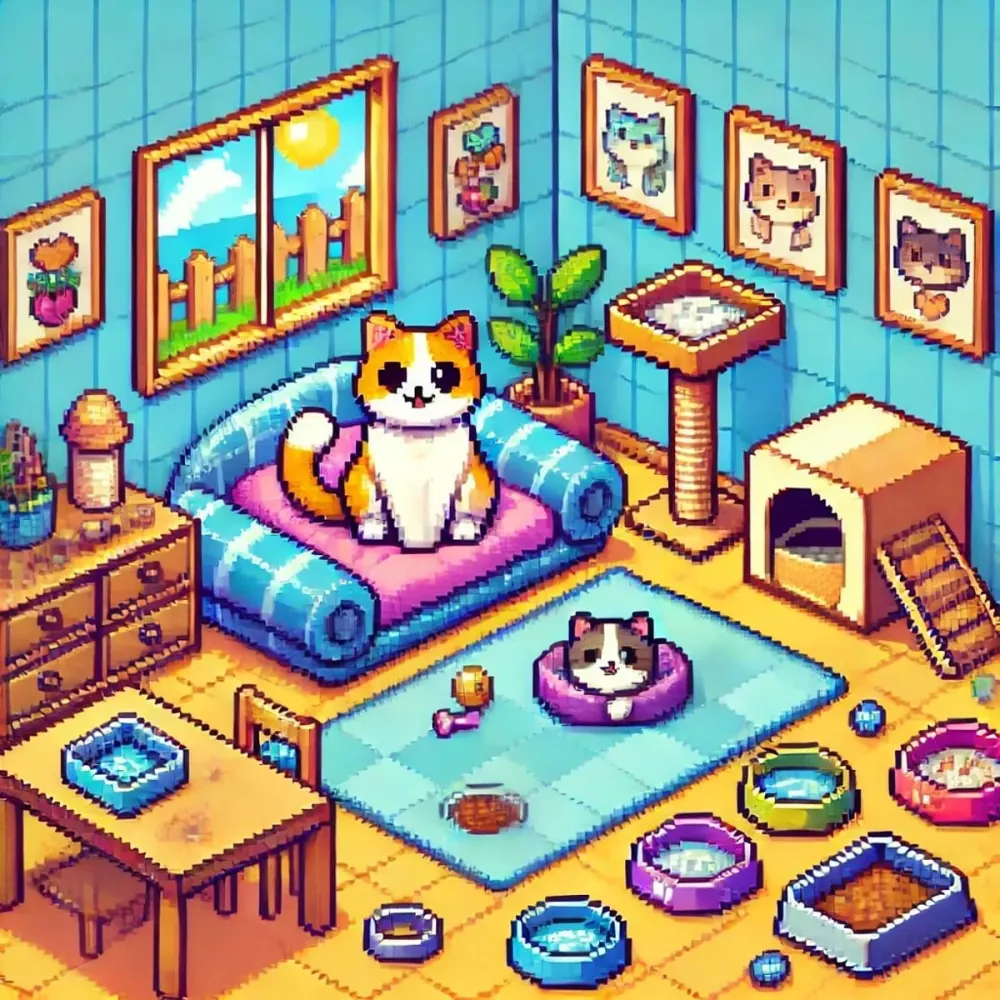
Not every cat lover can have a cat at home right now. If that is you, the Token Tails game is a cozy pixel cat game in your browser: meet your cat, visit the Shelter to meet cats from Pink Paw, a real cat shelter in Kaunas, Lithuania, and play Purrsuit or Paw Match. There is no sign-up needed to start. For more games like it, see our guide to virtual pet cat games.
A simple daily routine to start with
If 15 ideas feel like a lot, start with three:
- Two or three very short wand-toy games a day, each ending in a catch and a treat.
- Part of the daily dry food in a puzzle feeder or an egg box.
- One high spot by a window, and one box to hide in.
Watch what your cat uses, and build from there. Every cat is different, and the best enrichment is the kind your cat actually chooses.
Frequently asked questions
How much play does an indoor cat need?
There is no single number. International Cat Care describes cats as sprinters, not marathon runners: one minute of frenzied play is a good result, and short, frequent sessions match a cat's natural hunting pattern better than one long one.
Are laser pointers OK for cats?
Used with care. A laser lets a cat stalk and chase but never catch, so International Cat Care suggests switching to a wand toy to end the game on a catch. Best Friends adds: never shine the laser in your cat's eyes.
What are the signs of a bored or stressed indoor cat?
International Cat Care lists hiding, over-grooming, changes in eating or toileting, and becoming reactive towards people or other cats among the signs of stress. Some of these can also mean illness, so ask your vet if you see a change.
What is the cheapest way to enrich an indoor cat?
Cardboard boxes, wadded-up paper, scattering part of the daily food for your cat to find, and a comfortable spot by a window all cost little or nothing.
Check it yourself
Facts checked against live data on . Live figures change: the links below always show the current ones.
- International Cat Care: Playing with your cat(opens in a new tab)
- International Cat Care: Making your home cat friendly(opens in a new tab)
- International Cat Care: Understanding the hunting behaviour of cats(opens in a new tab)
- International Cat Care: Scratching on furniture and carpets(opens in a new tab)
- International Cat Care: Stress in cats(opens in a new tab)
- International Cat Care: Pen and cage setup (shelters and clinics)(opens in a new tab)
- Best Friends Animal Society: Cat enrichment(opens in a new tab)
- FECAVA: Environmental enrichment for indoor cats(opens in a new tab)
- Every payout for Pink Paw, with its transaction
- Impact: totals with dates and sources
- The open-source payout contracts (MIT)(opens in a new tab)