
Written by the Token Tails team. Facts checked against live data on ; sources are listed at the end.
A rescue cat settles in best in one quiet room with food, water, a litter tray and somewhere to hide, a steady daily routine, and no pressure to come out. Some cats take several weeks to feel at home, and very nervous cats can take months; that is normal.
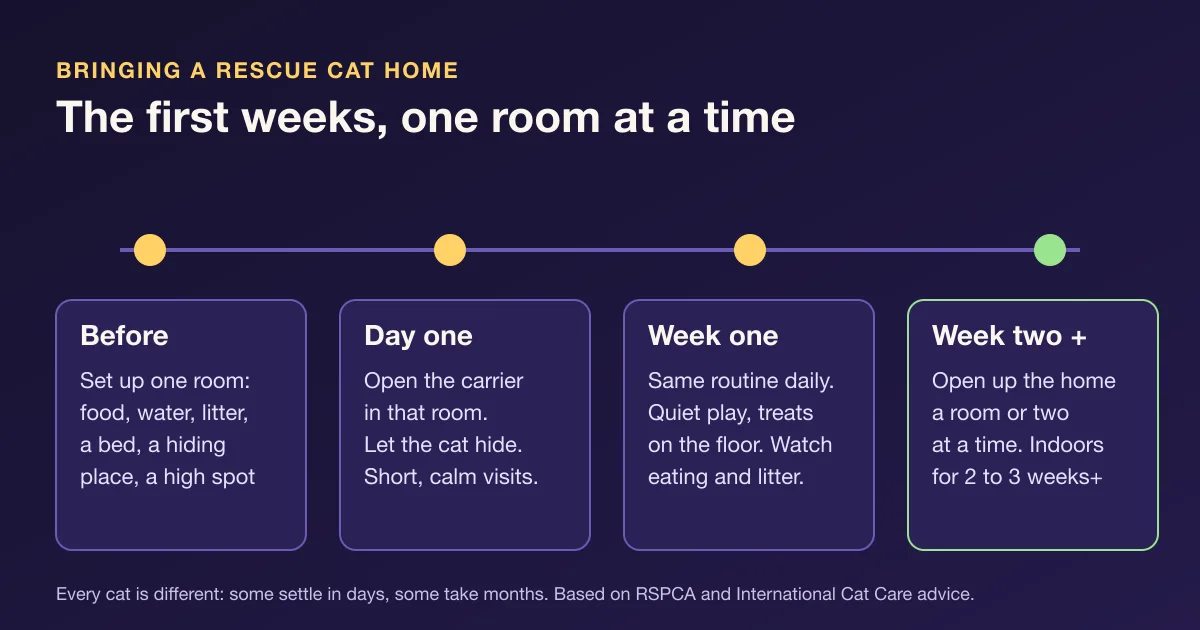
This guide walks through the first two weeks: what to set up before your cat arrives, what to do on day one, how the first week usually goes, how to open up the rest of the home, and which signs mean it is time to call the vet.
Key takeaways
- Start in one cat-safe room, not the whole house.
- Let your cat hide. Never pull a cat out; sit quietly and let it come to you.
- Keep feeding and play at the same times each day.
- Open up the home a room or two at a time, and introduce other pets slowly.
- Keep a new cat indoors for at least two to three weeks; call your vet if it stops eating or using the litter tray.
Before your rescue cat arrives: set up a safe room
Access to the whole house at once is overwhelming for most new cats. If you just let them loose, the RSPCA warns, “you’ll likely find that they hide away in fireplaces, behind sofas and in any other small gaps they can find!” (RSPCA). Instead, prepare one room with:
- Food and water, apart from each other.
- A litter tray, as far from the food and water as the room allows.
- A hiding place: a covered bed, a cardboard box on its side, or the carrier with its door open.
- Somewhere to get up high: a cat tree, a sturdy chair or a cleared shelf.
- A comfortable bed and a scratching post.
- Something that smells familiar, such as a blanket from the shelter.
- A window to look out of, kept securely shut.
Make the room safe: block off fireplaces and small gaps where a cat could get stuck, put away cords, small objects and plants, and check windows. International Cat Care suggests avoiding a room with full-length curtains for kittens, who will happily climb to the top (iCatCare).
Cornell’s Feline Health Center gives a simple rule for litter trays in the long run: one per cat plus one, in quiet, less-busy spots, cleaned at least once a day (Cornell). Ask the shelter which food and litter the cat is used to, and start with the same.
Day one: let them hide
Carry the cat straight to its room, put the carrier down next to the hiding place, open it and close the door behind you. “Just let your cat come out of their carrier in their own time – don’t try to take them out, slow and calm is best,” the RSPCA says (RSPCA). Some cats stay in the carrier for hours.
On the first day:
- Keep visits short and calm, keep the house quiet, and save visitors for later.
- Don’t try to coax the cat out of hiding. International Cat Care suggests you “spend time in the same room reading or watching TV, and allow your kitten to come to you when they feel ready” (iCatCare).
- Check that water is full and the litter tray is clean, then leave the cat to rest.
Some cats eat little at first. Keep an eye on it, and call your vet if your cat is still not eating or drinking (see the list below).
The first week: routine and quiet company
The first week is about trust.
- Keep a routine. The RSPCA advises keeping “the main activities like feeding and play to around the same time each day” (RSPCA).
- Talk softly when you’re in the room, so the cat learns your voice and household sounds.
- Use treats on the floor. Put a treat down and move away, so the cat can take it without feeling crowded.
- Let the cat choose contact. Stroke only if the cat comes to you and seems relaxed, and stop if it pulls away.
- Watch eating, drinking and litter use. They are your best signs of how the cat is coping.
A cat ready to move on is “eating, drinking, using the litter box and moving around the room in a relaxed manner,” says the ASPCApro foster guide; running when you enter, or eating and using the tray only at night, means it needs more time (ASPCApro).
Week two and beyond: open up the home
When your cat is relaxed in its room and reliably eating and using the tray, you can start opening up the home. The RSPCA suggests propping the door open a little so the cat can wander out in its own time, giving access to a couple of rooms at a time, and making sure it can always get back to its room or a hiding place (RSPCA).
As the cat explores, add food, water, beds, scratching posts and litter trays around the home, and leave the safe room’s set-up in place until the cat is using the new spots.
International Cat Care notes that “it can take some cats several weeks to feel safe in a new home, so patience is key” (iCatCare). The RSPCA’s own booklet includes a pair of very nervous cats that hid under a bed for their first two or three months, and went on to become confident family cats.
Once your cat is settled, our list of indoor cat enrichment ideas has 15 ways to keep it busy and happy.
Introducing other pets
“Don’t rush to introduce your new kitten or cat to other cats and dogs in the household – this must be done slowly and carefully,” International Cat Care warns (iCatCare). For cats, its step-by-step approach is (iCatCare):
- Separate rooms first. The new cat stays in its own room while it settles, which may take from several days to a week or two.
- Scent before sight. Swap a piece of each cat’s bedding so they get used to each other’s smell.
- See, but don’t touch. Let them see each other through a glass door, a stair gate or a mesh screen.
- Short, calm meetings only when both cats are relaxed.
Slow down if either cat avoids or hisses at the other’s bedding, and distract them if they hiss or growl through the barrier. If introductions are not going well, ask your vet or a qualified behaviourist for help.
Normal stress or time to call the vet?
Some stress is expected: hiding and a quieter appetite on the first day are common. International Cat Care’s list of stress signs also includes over-grooming and becoming reactive towards people or other cats (iCatCare), and it notes that “illness or pain can trigger these behaviours” in a new cat (iCatCare).
Call your vet if your new cat shows signs like these, taken from the urgent list in the ASPCApro foster guide (ASPCApro):
- not eating or drinking
- straining to urinate, or not urinating for more than 24 hours (this can be an emergency)
- no stool for more than two days
- diarrhoea, vomiting, sneezing or coughing
- lethargy or unusual behaviour, or being unable to stand or walk
- difficulty breathing
This is not a full list, and it is not medical advice. If something worries you, ask your vet. The shelter you got your cat from is also a good first call: they know the cat and often have advice on its habits.
Cornell’s Feline Health Center advises a vet visit once a year for adult cats, twice a year from about age ten, and a series of visits for kittens’ vaccinations (Cornell).
Keeping a rescue cat indoors at first
Even if your cat will eventually go outside, keep it indoors at first. The RSPCA says to keep a new cat indoors “for around two to three weeks before letting them outside for the first time” (RSPCA), and International Cat Care advises at least two to three weeks for adult cats; kittens should wait until at least a week after their first course of vaccinations (iCatCare). Ask your vet about vaccinations, microchipping and sterilisation before your cat’s first trip outside.
Cornell’s Feline Health Center recommends keeping cats indoors, or giving them an outdoor enclosure or supervised harness walks, because cats outside unsupervised face more infectious disease and parasites, injuries from cars and other accidents, and run-ins with other animals (Cornell). Ask your shelter and vet what fits your area and your cat.
How to thank the shelter
Shelters love hearing how their cats are doing. A few simple ways to say thank you:
- Send an update photo after the first few weeks. It often makes the staff’s day.
- Give something back: check their wish list for food, litter or cleaning supplies; see what cat shelters need.
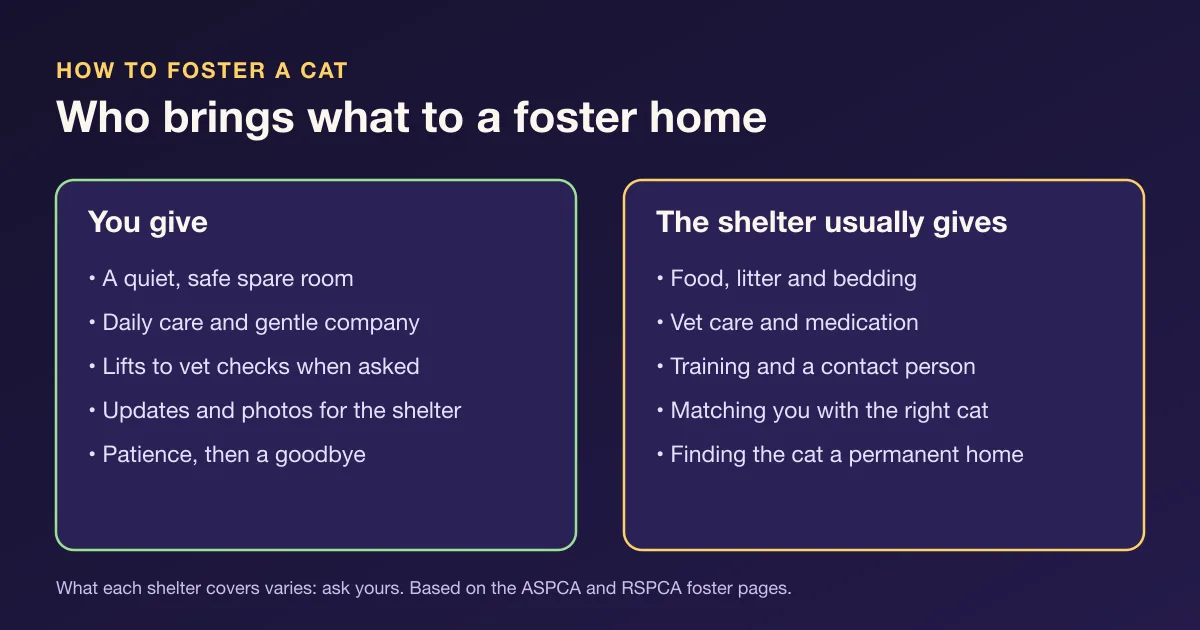
- Help in other ways: free ways to help animal shelters has ideas that cost nothing, and if you have room for another cat for a while, consider fostering.
Pink Paw (Rožinė pėdutė), the cat shelter in Kaunas, Lithuania that our games are built around, also looks after its cats until they find homes; read more about Pink Paw.
While your new cat settles
If you want something gentle to do while your cat decides you’re safe, the Token Tails game is a cozy pixel cat game in your browser, with Pink Paw’s real cats in its Shelter. No sign-up needed to start.
Settling in a rescue cat is mostly about doing less: one room, a routine, quiet company and time. Let your cat set the pace.
Frequently asked questions
How long does it take a rescue cat to settle in?
It varies a lot. International Cat Care says some cats take several weeks to feel safe in a new home; the RSPCA expects a few days before a cat is ready for the whole house. Very nervous cats can take months.
My new cat won't come out of hiding. What should I do?
Leave them be. Hiding is a normal way for cats to cope. Don't pull them out; sit quietly in the room, talk softly and put treats on the floor. If the cat is not eating, drinking or using the litter tray, call your vet.
When can a rescue cat go outside?
The RSPCA and International Cat Care both suggest keeping a new adult cat indoors for at least two to three weeks. International Cat Care says kittens should wait until at least a week after their first course of vaccinations; ask your vet. Cornell's Feline Health Center recommends keeping cats indoors, or giving them an outdoor enclosure or supervised harness walks.
How do I introduce my rescue cat to my other cat?
Slowly. International Cat Care suggests keeping them apart at first, swapping bedding so they get used to each other's scent, then letting them see each other through a barrier before any meeting. Slow down at any sign of hissing or tension.
Check it yourself
Facts checked against live data on . Live figures change: the links below always show the current ones.
- International Cat Care: Helping your new cat or kitten settle in(opens in a new tab)
- International Cat Care: Introducing cats(opens in a new tab)
- International Cat Care: Stress in cats(opens in a new tab)
- RSPCA: Getting ready for your RSPCA rescue cat (PDF)(opens in a new tab)
- ASPCApro: Feline foster care guide (PDF)(opens in a new tab)
- Cornell Feline Health Center: What to expect when adopting a feline friend (PDF)(opens in a new tab)
- Every payout for Pink Paw, with its transaction
- Impact: totals with dates and sources
- The open-source payout contracts (MIT)(opens in a new tab)