
Written by the Token Tails team. Facts checked against live data on ; sources are listed at the end.
You can help an animal shelter for free by sharing its animals, giving your time or skills, fostering, collecting the goods it asks for, and using free tools where a sponsor pays for your tap. Some of these move real money to the shelter; most of them help in other ways, and that is just as useful.
Here are twelve, with an honest note on which is which.
Key takeaways
- Much of the most useful free help is people: foster homes, volunteers and shares that reach the right home.
- Always ask for the shelter’s current wish list before you collect goods.
- Some “free” actions move money because a sponsor pays. Check who the sponsor is, what the cap is, and whether the payout is public.
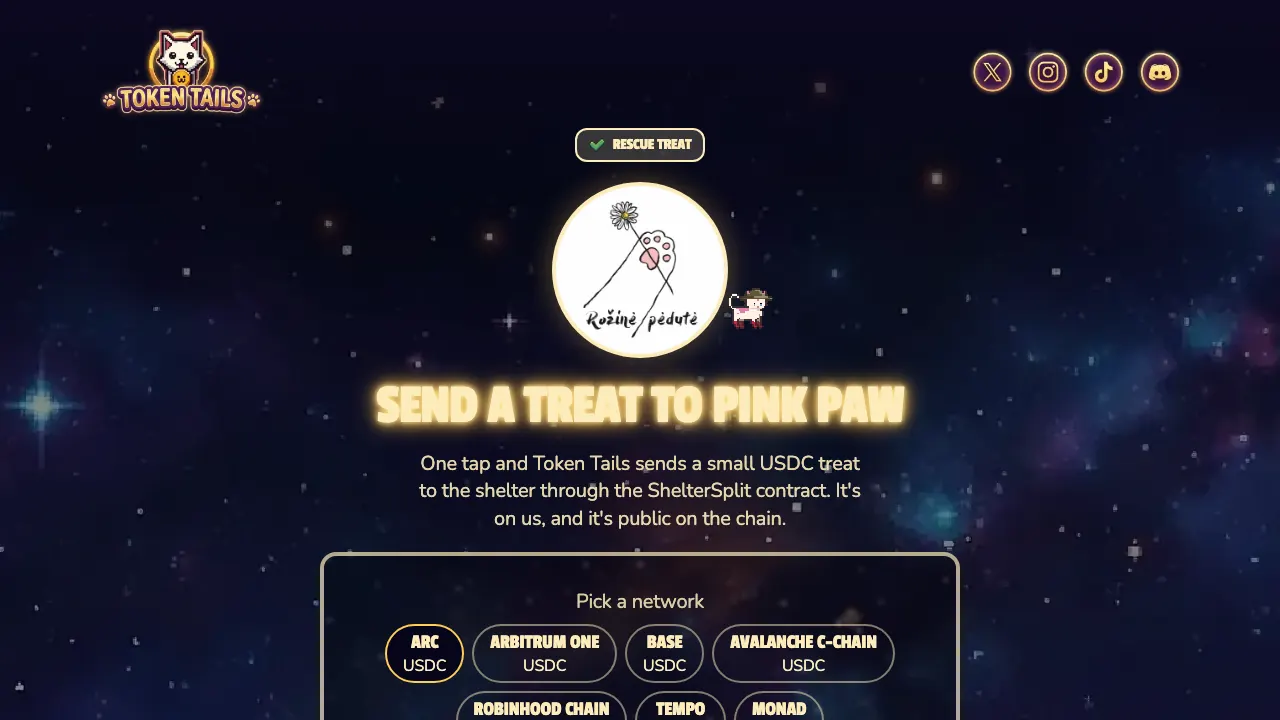
- On the Token Tails give page, one tap and Token Tails sends Pink Paw a free 0.01 USDC treat from its own budget.
Which free actions actually move money?
| Free action | Moves money to the shelter? | What it does |
|---|---|---|
| Sharing animals and appeals | No | Finds homes, fosters and donors |
| Volunteering (in person or online) | No | Gives staff time back |
| Fostering | No | Frees a shelter space; the shelter or rescue usually covers the costs |
| Collecting wish-list goods | Indirectly | Saves the shelter buying them |
| Tax-share schemes (where they exist) | Yes | Part of tax you already pay goes to the shelter |
| Sponsored taps and game treats | Yes, small amounts | A named sponsor pays for each tap |
| Reviews and word of mouth | No | Builds trust with future visitors and givers |
1. Share the shelter’s animals the right way
A share is the cheapest help there is, and it works best when it points to the source. Share the shelter’s own post or page, not a screenshot, so people land where they can actually ask about an animal. Add one line of your own (“Shy but sweet, good with other cats”) and it travels further.
2. Volunteer your skills online
Many shelters need help they can get from anyone with a laptop: editing photos, writing animal profiles, running social media, translating, or keeping spreadsheets. Best Friends Animal Society, for example, describes a remote volunteer who collected and summarised studies for its education work from home (Best Friends). Email your local shelter and offer one specific skill; it is easier to say yes to than “anything”.
3. Volunteer in person
Cleaning, laundry, socialising shy cats, walking dogs and driving animals to the vet all take hours that staff rarely have. Expect an induction and a regular slot: reliability matters more than enthusiasm.
4. Foster
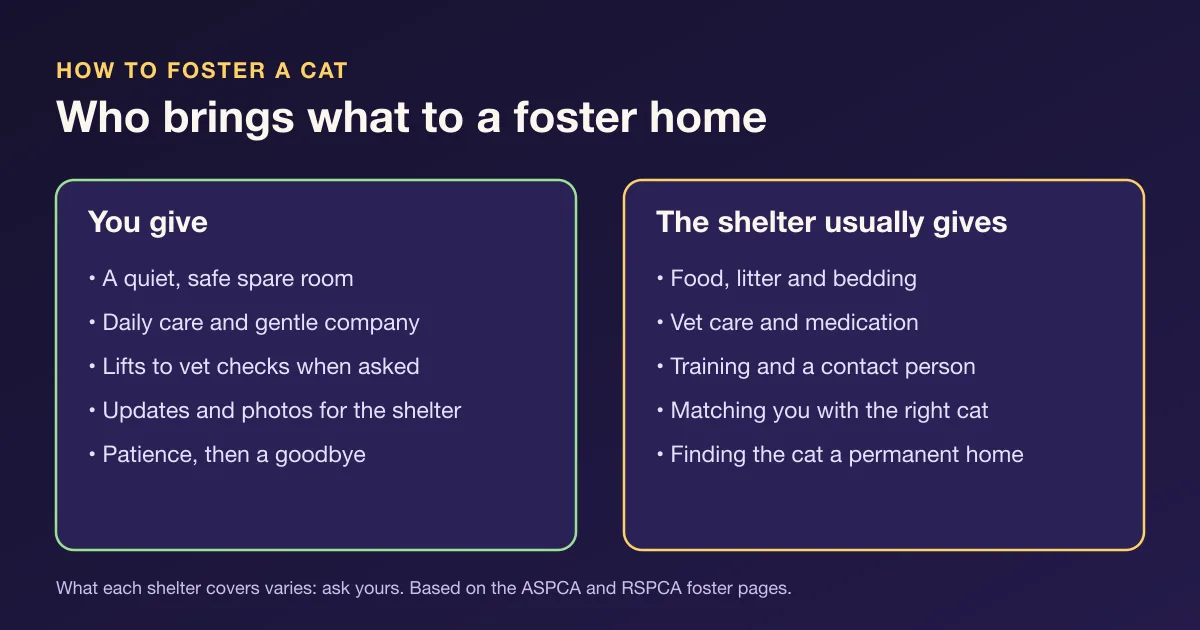
Fostering takes an animal out of the shelter and into your home for a while, which frees a space for the next one. The shelter or rescue usually provides food and supplies and covers vet care (ASPCA; RSPCA). Our guide on how to foster a cat walks through what to expect.
5. Ask for the wish list before you give goods
Unrequested items can cost a shelter time to sort and store. Ask first, then collect what is on the list: often cleaning supplies, litter and a specific food. See what cat shelters need for the usual asks and what to avoid.
6. Run a collection
You do not have to buy anything yourself. A box at work, school or a birthday party, with the shelter’s list taped on top, turns other people’s spare items into exactly what the shelter needs.
7. Use a tax-share scheme if your country has one
Some countries let you send part of the income tax you already pay to a registered organisation, at no cost to you. In Lithuania, for example, people can assign 1.2% of their income tax to a non-profit; Pink Paw explains how on its support page. Check what your country offers.
8. Leave a review and tell your friends
A short, honest review on Google or Facebook helps the next person decide to visit, foster or give. Mention what you saw: clean rooms, staff who knew each animal by name, honest answers.
9. Help strays the right way
If you see an injured or clearly lost cat, contact your local shelter or rescue instead of waiting for someone else to. Our guide on how to help stray cats covers what to do, and when to leave a healthy community cat alone.
10. Tap to send a sponsored treat
This one moves real money, paid by a sponsor, not by you. On the Token Tails give page, one tap and Token Tails sends Pink Paw, a cat shelter in Kaunas, Lithuania, a 0.01 USDC treat (USDC is a digital dollar) on Arc, the default network.
- Who pays: Token Tails, from its own budget. It costs you nothing, and you need no account.
- The cap: on Arc, Token Tails sets aside 1 USDC of treats a day, which is up to 100 treats; other networks have their own daily limits. The count resets at 00:00 UTC, and you can send one a day.
- The proof: every treat is a public payout. Open the shelter payouts page and follow any one to its transaction; the impact page shows the running count.
It is small on purpose. One cent is not going to pay a vet bill; the point is a free action that is real, capped and checkable.
11. Play games that help
A few games tie a win to a real gift. In Catnip Heist, a free browser stealth game, a win can unlock the same free treat for Pink Paw (one a day), paid by Token Tails. Our round-up of charity games that help animals lists more and explains who pays in each case.
12. Check appeals before you share them
Fake rescue appeals spread through the same shares real ones do. Before you pass one on, check that the rescue is registered, reachable and consistent across its own channels. Our checklist on how to tell if an animal rescue is legit walks through the checks.
How to check a free action is real
Any “click to help” offer should pass three tests:
- The sponsor is named. Someone has to pay. If a page cannot say who, assume nobody does.
- The amount and the cap are public. “We donate for every click” means little without a value per click and a daily limit.
- The payout is checkable. You should be able to see what was actually paid, to whom and when: a published report, a receipt, or a public record like a verifiable on-chain payout.
Token Tails’ treats are built to pass all three: Token Tails pays, the cap is public (1 USDC of treats a day on Arc), and every payout is listed on /shelter-payouts. To see how the whole system fits together, read how Token Tails works.
Frequently asked questions
Do free click-to-give sites really donate?
Some do: a sponsor or advertiser pays for each click. Before you rely on one, check that it names who pays, publishes how much each click is worth and the daily cap, and shows a record of what was actually paid out.
How much is a free Token Tails treat worth?
Each treat is 0.01 USDC (USDC is a digital dollar, so about one US cent), sent to Pink Paw, a cat shelter in Kaunas. On Arc, the default network, Token Tails sets aside 1 USDC of treats a day, up to 100 treats, and the count resets at 00:00 UTC. Other networks have their own daily limits.
Who pays for a free treat?
Token Tails does, from its own budget. Your tap only starts it; it costs you nothing, and you need no account. Every treat appears on the public shelter payouts page.
What is the most useful free thing I can do for a shelter?
Ask the shelter. Many shelters ask for foster homes and reliable volunteers, and their wish list tells you which goods help right now.
Check it yourself
Facts checked against live data on . Live figures change: the links below always show the current ones.
- ASPCA: what it means to be an animal foster caregiver(opens in a new tab)
- RSPCA: how to foster a cat(opens in a new tab)
- Best Friends Animal Society: virtual volunteering(opens in a new tab)
- Pink Paw (Rožinė pėdutė): ways to support, including the 1.2% tax share(opens in a new tab)
- Send a free treat (Token Tails give page)
- Every treat and payout, with its transaction
- Impact: totals with dates and sources
- The open-source payout contracts (MIT)(opens in a new tab)