
Written by the Token Tails team. Facts checked against live data on ; sources are listed at the end.
Games can help animals when someone attaches real money to playing: a sponsor pays per answer, ads fund a shelter, a purchase shares its price, or a stream raises donations. The good ones name the shelter, state the amount per action, and let you check that the money arrived.
This guide explains how each model works, gives real examples, and ends with a checklist you can use on any game, including ours.
Key takeaways
- In a free charity game, the money comes from someone else: a sponsor, advertisers, or the game company.
- Trust a game when it names the recipient, states the amount per action, and shows proof.
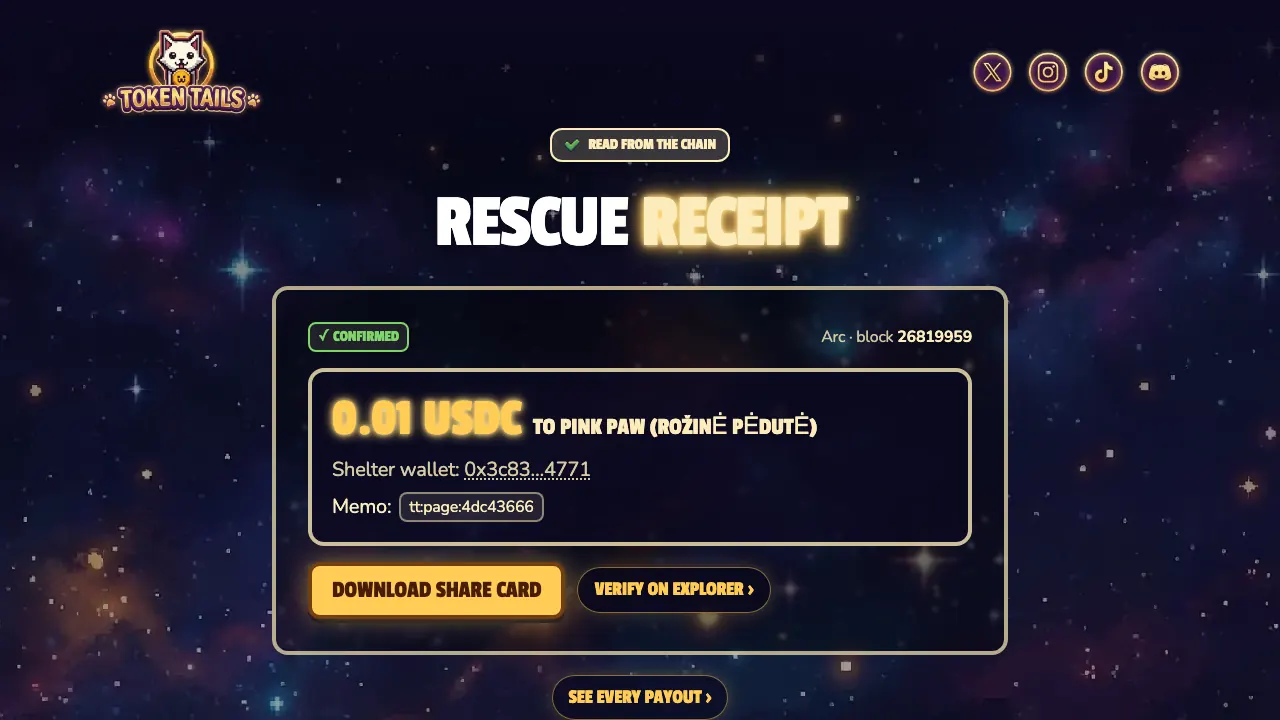
- In Catnip Heist, win a run and tap once, and Token Tails sends Pink Paw, a cat shelter in Kaunas, a 0.01 USDC treat. Each payout is public at /shelter-payouts.
How games can help animals
There are four common models. Each one has a different answer to the only question that matters: who pays?
- Sponsor-funded actions. A sponsor promises a donation per action, such as per quiz answer or per in-game feeding. It costs the player nothing; the sponsor’s budget sets the limit.
- Ad revenue. The game or app shows ads and gives part of the ad income to a charity. The more people use it, the more ads are shown.
- Purchases. Part of the price of an item goes to a shelter. The share matters: “50% of each $5” and “all proceeds” are very different promises.
- Streams and events. Players or creators stream a game and ask viewers to give to a shelter directly. The game is the reason people gather, not the payment channel.
Real examples
These are described from their own pages and from press coverage. We have not audited any of them.
Freekibble. A free trivia site. It says: “Click on an answer and we’ll provide kibble and supplies to animal shelters”. Right or wrong answers both count, and its sister site Freekibblekat does the same for cats. According to the site, the funds are paid by Greater Good Charities to the benefiting organizations as a grant. (freekibble.com)
Tab for Cats. A browser extension from Gladly that turns each new tab into a small page with a few ads. Gladly says the ad revenue funds its charitable work, and Tab for Cats supports Greater Good Charities’ The Jackson Galaxy Project, which supports shelter cats and the people who care for them. (tab.gladly.io/cats)
Avia’s Play for Paws (2025). A time-limited event in the mobile games Solitaire Clash and Bingo Tour. Players could feed animals in the game; Avia said it would donate to the Nevada SPCA for every feeding action. The animals in the event were real rescue animals at that shelter. (Business Wire)
Stray (2022). Playing Stray did not trigger a donation. Its launch inspired charity streams and fundraisers for cat shelters, and press reports described its publisher, Annapurna Interactive, supporting shelters such as the Nebraska Humane Society. (80.lv)
A checklist before you trust a charity game
Use these six questions on any game that says it helps animals.
- Is the recipient named? “A real shelter in Kaunas” or “the Nevada SPCA” is checkable. “Animals in need” is not.
- Is the amount per action stated? You should be able to tell what one quiz answer, one win or one purchase is worth to the shelter.
- Who pays? A sponsor, advertisers, the game company or you. Each is fine, as long as the game says which.
- Can you check it without trusting the company? Grant reports, receipts from the shelter, or public transactions all count. A big number on a banner does not.
- Is it still running? Many campaigns last a few weeks. A page from last year may describe an event that has ended.
- Is the small print honest? If only part of a purchase reaches the shelter, a trustworthy game says what part.
Token Tails: who pays what
Token Tails makes free cat games tied to one shelter, Pink Paw (Rožinė pėdutė) in Kaunas, Lithuania. Here is how it answers the checklist.
- Recipient: Pink Paw. Since 16 October 2026 the payout contracts pay Pink Paw’s own wallet. Token Tails created that wallet and keeps a recovery backup; the shelter’s staff hold the recovery phrase.
- Amount per action: after a win in Catnip Heist, one tap and Token Tails sends Pink Paw a 0.01 USDC treat (one treat per player per UTC day).
- Who pays: Token Tails pays for the treats from its own budget, capped at 1 USDC of treats a day. In Moon Rave, the giver pays: $1 = 1 cat, by card (Token Tails pays the full $1 out to Pink Paw on-chain) or in USDC on Arc (the full $1 goes from the giver’s wallet to the Pink Paw split).
- Proof: each on-chain payout is listed at /shelter-payouts, with a link to its transaction on a public block explorer.
- Still running: the treat budget resets every day at 00:00 UTC, and the live state is shown on the payouts page.
- Small print: Pink Paw’s share is 50% of each $5 shelter cat, not all of it, and the shelter cats guide says so.
How to check a payout yourself
Open /shelter-payouts, pick any payout, and open its transaction. You will see the coin, the amount and the receiving wallet, recorded on a public network that neither Token Tails nor anyone else can edit afterwards. The full walkthrough is in How to verify a crypto donation.
Live from the payout ledger
The bottom line
Games that help animals are real, but they vary a lot. The best ones tell you who covers the cost, how much reaches the shelter, and where to check. If a game cannot answer those three questions, enjoy it as a game, and give to a shelter you trust directly.
If you want a free one that answers all three, play Catnip Heist. For more free games, see Free cat games online.
Frequently asked questions
Do free games that help animals really donate?
Some do. The money usually comes from a sponsor, from ads, or from the game company's own budget. Look for a named shelter, a stated amount per action, and a way to check the payments.
Who actually pays when I play a free charity game?
Not you. The money comes from a sponsor, an advertiser or the game company. In Catnip Heist, Token Tails pays for each treat from its own daily budget.
How can I check that a game's donation was made?
Look for grant reports, receipts from the shelter, or public transactions. Token Tails lists every on-chain payout to Pink Paw at tokentails.com/shelter-payouts, each linked to its transaction.
Are charity game campaigns permanent?
Often not. Many are time-limited events. Check the dates before you assume your play still counts.
Check it yourself
Facts checked against live data on . Live figures change: the links below always show the current ones.
- Freekibble(opens in a new tab)
- Tab for Cats (Gladly)(opens in a new tab)
- Avia and Nevada SPCA: Play for Paws (Business Wire, Aug 2025)(opens in a new tab)
- How Stray made a real-life impact on cat rescue (80.lv)(opens in a new tab)
- Token Tails shelter payouts
- Impact: totals with dates and sources
- The open-source payout contracts (MIT)(opens in a new tab)