
Written by the Token Tails team. Facts checked against live data on ; sources are listed at the end.
To sponsor a cat online, you sign up on a shelter’s or charity’s website for a regular gift (usually monthly) toward its cat care, and in return you get updates on a cat or a pen of cats. Sponsorship does not change where the cat lives: the shelter keeps caring for it and keeps looking for its new home.
Below: how two well-known schemes describe their own sponsorship, the questions worth asking before you sign up, and smaller one-off ways to help a shelter if a monthly plan is not for you.
Key takeaways
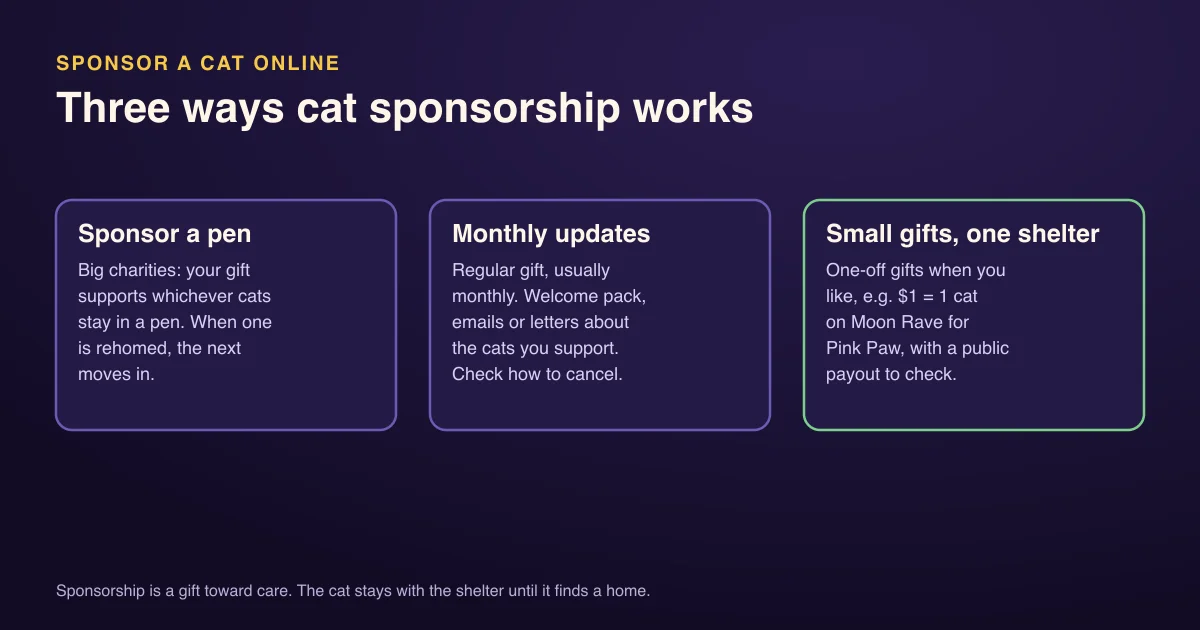
- Sponsorship is a gift toward care, not ownership. The cat stays with the shelter until it finds a home.
- Big charities often have you sponsor a pen: when one cat is rehomed, the next cat moves in.
- Before you sign up, ask what the money covers, how often you hear back, and how to stop.
- If you prefer one-off gifts, you can give $1 at a time to Pink Paw, a small shelter in Kaunas, and check each payout on a public page.
How cat sponsorship works
Most sponsorship schemes share the same shape: a regular gift, a welcome pack, and news about the cats your money supports. The details differ, so here is how two large UK charities explain theirs, in their own words (checked on 20 October 2026).
Cats Protection sponsors sign up for a pen, not one cat. Its FAQ explains that you sponsor a pen at one of its centres, “So whenever we rehome a cat, a new cat will take their place.” Sponsors get updates about the cats in their pen, including through an online portal, and the page says sponsorship starts “from just £6 a month”. Sponsors are welcome to visit a centre if they call first.
Woodgreen works in a similar way. Its page says sponsorship supports “lots of homeless pets, one after the other”: when one finds a home, another comes in. It lists monthly email updates, three postal updates a year, a welcome pack and a certificate, starting from £6.50 a month.
Why a pen and not one cat? Because the goal of a shelter is for cats to leave. A scheme tied to one cat would end the day that cat finds a family. A pen keeps your gift useful for as long as you give.
What your sponsorship pays for
Each charity says this in its own words, and it is worth reading them rather than guessing:
- Cats Protection says sponsorship “helps fund the food, shelter and medical care of every cat that stays in your pen”.
- Woodgreen lists a safe, warm shelter, nutritious food, medical checks and life-saving operations, plus toys, games and behaviour training to help pets find the right home.
In other words, sponsorship money usually goes into the general cost of caring for the cats, not into a separate pot for one animal. That is a good thing: a shelter can then spend it where it is needed that week, whether that is a vet bill or cat litter. Our guide to what cat shelters need goes into the everyday costs.
Questions to ask before you sign up
A good scheme answers these on its website or by email:
- What exactly does my gift cover? Look for the charity’s own wording, as above.
- Do I sponsor a cat, a pen or a centre? And can I choose which one?
- How often will I hear back? Monthly emails, a few letters a year, or an online portal?
- How do I change or cancel it? Monthly gifts should be easy to stop.
- Is the charity registered? In England and Wales you can look it up on the Charity Commission register. For other checks, read how to tell if an animal rescue is legit.
If a scheme promises that your money pays for “your” cat alone, ask how that works when the cat leaves. Honest schemes are clear about it.
Sponsoring a cat at a small shelter abroad
Big charities have sponsorship teams and welcome packs. Small shelters usually do not. If you want to help a local shelter in another country, the simplest route is often a one-off or repeat donation on its own website. Our guide to donating to a cat shelter online covers ways to do that without large fees.
When there is no sponsorship scheme, you can make your own routine: put a reminder in your calendar and give the same small amount every month.
Smaller ways to help Pink Paw with Token Tails
Pink Paw (Rožinė pėdutė) is a cat shelter in Kaunas, Lithuania. Token Tails, the cat game studio that publishes this blog, has no sponsorship scheme, but there are three small ways to help Pink Paw, and it is plain who pays in each:
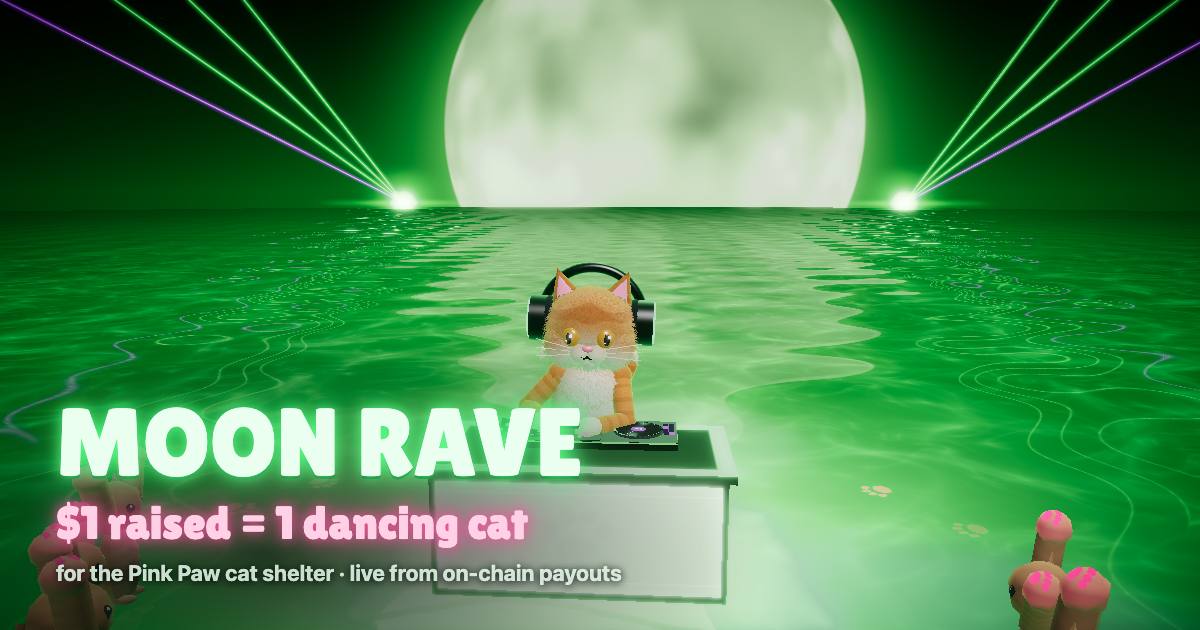
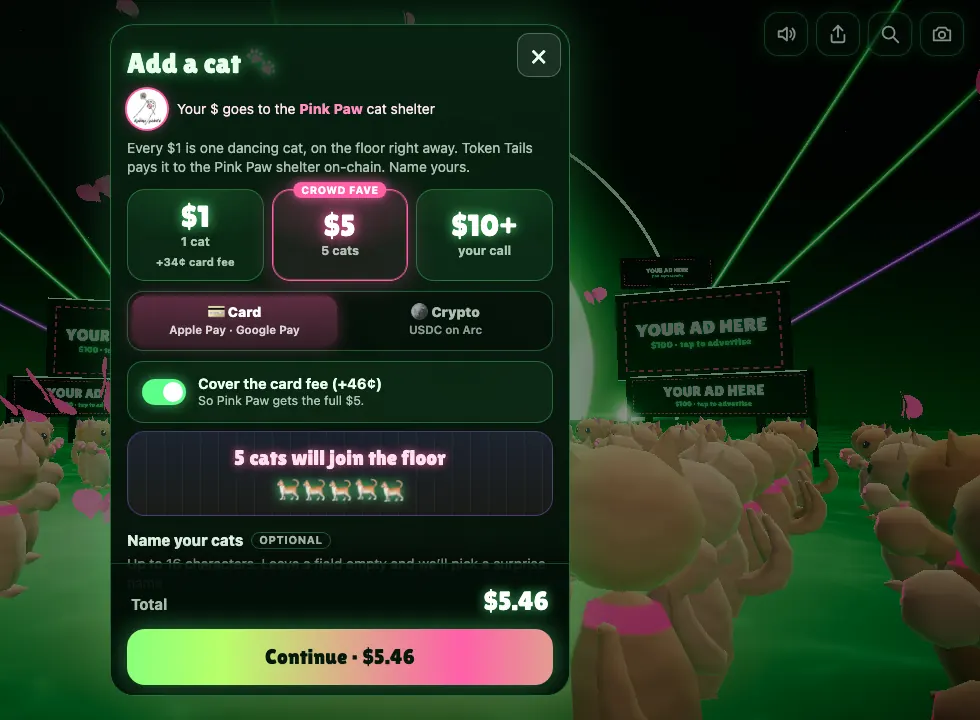
- Moon Rave, $1 = 1 cat. On Moon Rave you add a dancing cat to a live dance floor for each $1, and you can name it. By card, Token Tails pays the full $1 out to Pink Paw on-chain. In USDC on Arc, the giver’s wallet pays the Pink Paw split directly. Read how Moon Rave works.
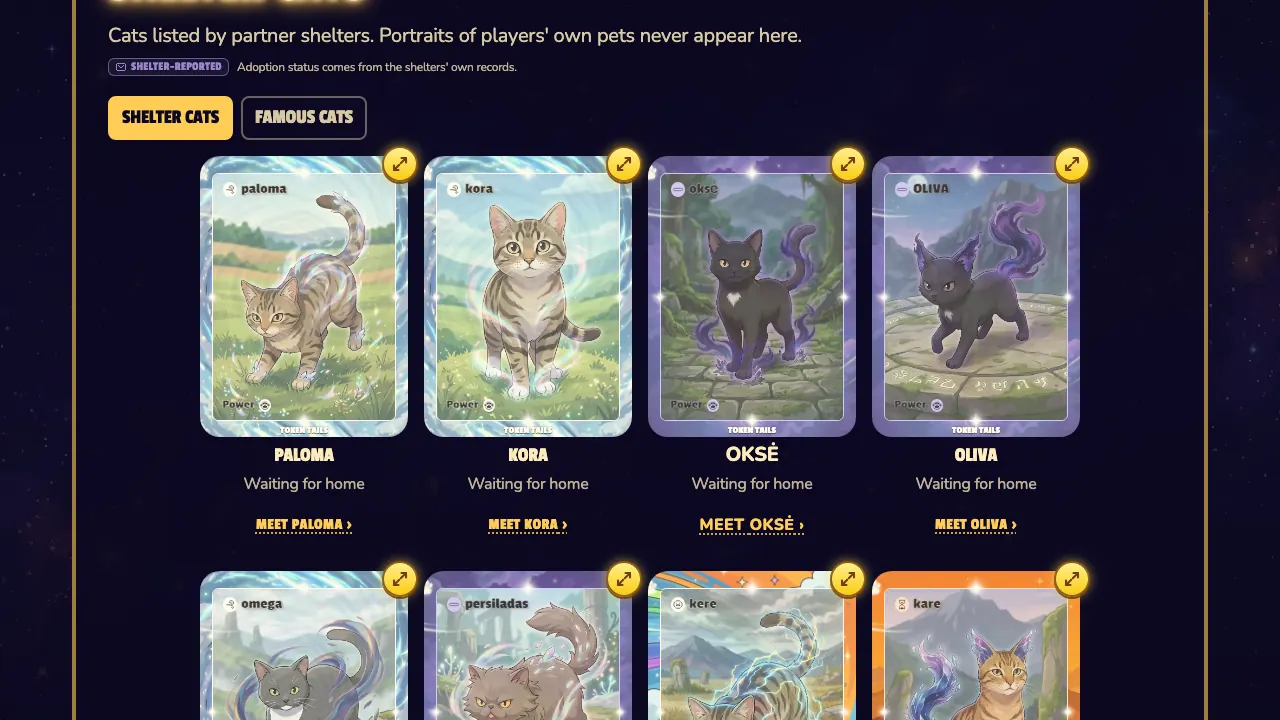
- $5 shelter cat cards. On the Token Tails website you can get a digital card of a real Pink Paw cat for $5. Pink Paw’s share is 50% of each $5 shelter cat. The card is a picture in a game: it does not change where the real cat lives. More in shelter cats in Token Tails, or browse them at /cats.
- Free treats. After a win in Catnip Heist, one tap and Token Tails sends Pink Paw a 0.01 USDC treat from its own budget (one treat per player per UTC day). It costs the player nothing.
None of these is a monthly plan, and none is a tax-deductible donation. They are small, quick gifts you can repeat whenever you like.
Seeing where the money goes
With most sponsorship schemes you trust the charity’s reports, which is reasonable for a registered charity. Token Tails adds one more layer: every payout to Pink Paw goes through an open-source contract and is listed on the shelter payouts page, each with a link to its transaction. The impact page shows the totals with a date and a label for where each figure comes from.
One thing to know when you look: many of those payouts are sponsor gifts from Motored, a company owned by Token Tails’ founder. They are labelled as sponsor money, a related party, and are not gifts from the public.
Live from the payout ledger
If you would like to check one payout yourself from start to finish, follow our guide to verifying a crypto donation.
Frequently asked questions
Is sponsoring a cat the same as taking one home?
No. Sponsorship is a gift toward a shelter's cat care. The cat stays at the shelter, or with the new family the shelter finds for it, and you do not become its owner.
Can I sponsor one specific cat?
It depends on the charity. Cats Protection and Woodgreen both say you support a pen or a series of cats rather than one cat, because cats move on to new homes. Some smaller shelters do offer named cats, so ask.
How much does it cost to sponsor a cat?
Each charity sets its own amount. On 20 October 2026, Cats Protection's sponsor page said from £6 a month and Woodgreen's said from £6.50 a month. Check the charity's own page for today's price.
Is cat sponsorship tax-deductible?
That depends on the charity and your country, so ask the charity. Gifts on Token Tails' Moon Rave are not tax-deductible, and Token Tails does not issue charity tax receipts.
Check it yourself
Facts checked against live data on . Live figures change: the links below always show the current ones.