
Written by the Token Tails team. Facts checked against live data on ; sources are listed at the end.
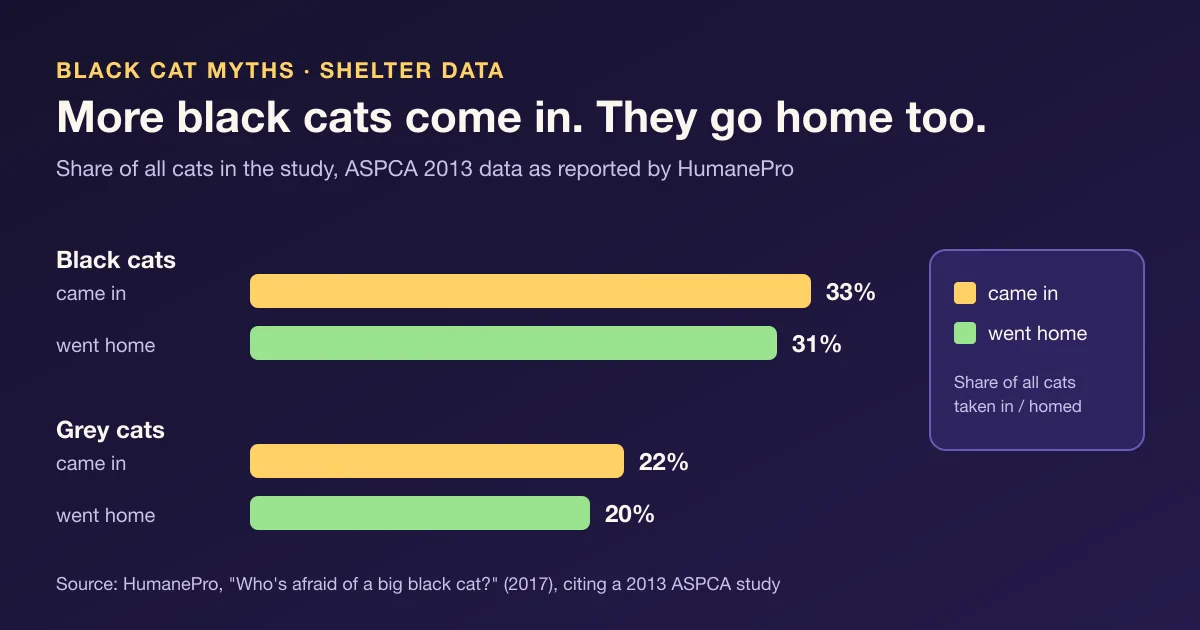
The idea that black cats are rarely adopted is mostly a myth, according to the best-known shelter data. A 2013 ASPCA study, as reported by HumanePro, found that black cats go home from shelters at about the same rate as other cats; there are simply more of them coming in, so they stand out on every rehoming page.
That still matters. More black cats in the building means more black cats waiting at any one time. This guide covers where the superstitions come from, what the data actually says, the yearly Halloween debate, and practical ways to help the black cats at your local shelter.
Key takeaways
- In a 2013 ASPCA study reported by HumanePro, black cats were 33% of cats coming into shelters and 31% of cats adopted.
- They look overlooked because more of them arrive, not because people pass them by much more often.
- The bad-luck idea comes from medieval European beliefs about witches; in UK folklore and in Japan, black cats mean good luck.
- Pausing black cat rehoming at Halloween is debated; many animal welfare voices now argue it does more harm than good.
- Good photos, sharing posts and fostering help black cats get noticed.
Where black cat superstitions come from
Black cats have meant very different things in different places.
Bad luck: medieval Europe. Black cats have long been considered bad luck in Europe and are still a symbol of witchcraft and Halloween. Wikipedia’s entry says the witchcraft link likely comes from Vox in Rama, a 13th-century letter by Pope Gregory IX that describes a demonic ritual involving a black cat (Wikipedia).
Good luck: Britain, Scotland and Japan. The same entry quotes the RSPCA saying in 2014 that “in UK folklore, black cats symbolise good luck,” and notes that in Scotland a black cat arriving at a new home signals prosperity, and that in Japan black cats are good luck and linked with the beckoning maneki-neko figurine (Wikipedia).
Sailors’ cats. Sailors choosing a ship’s cat were said to want a black one for luck, and fishermen’s wives kept black cats hoping to protect their husbands at sea (Wikipedia).
For more cats that shaped beliefs and history, from ancient Egypt onwards, see cats in history.
Are black cats adopted less? What the shelter data says
The most-cited numbers come from a 2013 ASPCA study. HumanePro, the professional site of a large US animal welfare charity, reported them like this (HumanePro):
| Colour | Share of cats coming into shelters | Share of cats adopted |
|---|---|---|
| Black | 33% | 31% |
| Grey | 22% | 20% |
In the article’s words, “black cats actually are adopted from shelters at the same rate as other cats—but because there are more black cats than any other-colored felines, it can appear as though they’re being overlooked.”
Vetstreet reported the same analysis in 2014: the ASPCA’s database drew on 14 communities and nearly 300,000 dogs and cats, black cats made up 33% of feline intake, and 31% of 2013 feline adoptions were black cats (Vetstreet).
Two honest caveats:
- This is one large dataset from US communities. Other studies have found different results, and the question is still debated (Wikipedia). Your local shelter’s experience may differ.
- It is not only about adoptions. In the same ASPCA data, black cats were also 30% of cats euthanised, at or near the top of the colour list and close to their 33% share of intake (Vetstreet).
- “Same rate” does not mean “no problem”. When a third of the cats in a shelter are black, a lot of black cats are waiting at once, and many of them look alike in small photos. That is a visibility problem, and it is one you can help with.
The Halloween question
Every October the same debate comes back: should shelters pause rehoming black cats around Halloween?
The case for pausing. Some shelters and rescues have stopped black cat adoptions in October, worried that people want the cats as costume props or, worse, to harm them. HumanePro describes a shelter leader who, early in her career, took black cats off the adoption floor for two weeks either side of Halloween for exactly that reason (HumanePro).
The case against. The same leader later concluded the policy backfired: cats kept longer in a crowded shelter got sick, and “We had the very best of intentions but the very worst of outcomes.” A 2016 HumanePro post argues there is “a clear lack of evidence that black cats are at increased risk of harm during this time of year,” while admitting that no one collects data that could settle it either way, and asks whether someone who goes through a full adoption process for a microchipped cat is likely to be the person who harms it (HumanePro).
Where things are heading. According to HumanePro, fewer organisations now refuse to rehome black cats in October, and some actively promote them at Halloween, relying on their normal screening to make good matches (HumanePro).
Policies are set shelter by shelter, so if you want a black cat this October, simply ask your local shelter how it handles the season.
Why black cats photograph badly, and how to fix it
Most people first meet a shelter cat on a phone screen. Black fur swallows light, so a black cat in a dim room can look like a dark blob with two eyes, and a page full of them looks like the same cat over and over.
HumanePro passes on some simple tips (HumanePro):
- Use window light. Place the cat near a large window so its face is lit.
- Skip the on-camera flash. It gives a harsh, yellowish light that flattens black fur.
- Add colour. A brightly coloured collar, toy or bed helps tell one black cat from the next.
A few general photo habits help too:
- Use a plain, light or colourful background rather than a dark sofa.
- Get down to the cat’s eye level, and wait for a moment of curiosity or play.
- Tap the screen on the cat’s face so the phone exposes for the fur, not the background.
- Write a description that shows personality: a black cat that “head-butts your chin every morning” is easier to remember than “black cat, 3 years”.
How to help black cats at your local shelter
You do not need to take a cat home to make a difference.
- Share their posts. One share of a good photo can reach the right person. It is one of several free ways to help animal shelters.
- Offer your photography. If you are handy with a camera, ask whether the shelter needs volunteer photos. Black cats benefit most.
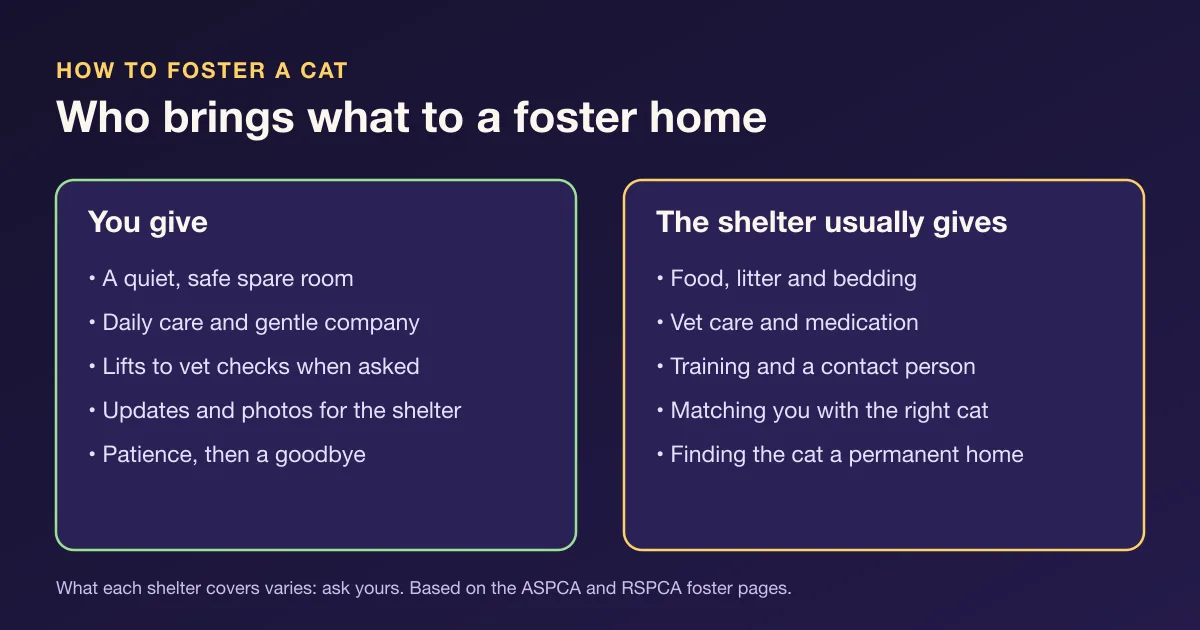
- Foster. A foster home lets a cat show its real personality, which makes for better photos and descriptions. Our guide on how to foster a cat covers what it involves.
- Give what the shelter needs. Money and the right supplies help every cat in the building; see what cat shelters need.
- Consider a black cat yourself. If you are ready for a cat, meet the black ones with an open mind. As one HumanePro article puts it, they are “just as cuddly” as any other cat.
If you want to help shelter cats from your sofa, there is also a free game for that. In Catnip Heist, two cats sneak past guard dogs to free a captive cat, and every shelter cat you free is shown next to a real cat at Pink Paw, a cat shelter in Kaunas, Lithuania. After a win, one tap and Token Tails sends Pink Paw a small treat; it costs you nothing.
Black cats deserve a fair look
The superstitions are old, and the “nobody takes black cats” story is mostly a numbers effect. What black cats need is the same as every shelter cat: to be seen clearly, described honestly and met by people with an open mind. If you have room for a cat, ask your local shelter to introduce you to its black cats first.
Frequently asked questions
Are black cats bad luck?
No. The bad-luck idea is folklore, linked in Europe to medieval beliefs about witches and the devil. In other places black cats mean the opposite: in UK folklore they symbolise good luck, and in Japan they are linked with the lucky beckoning cat.
Are black cats adopted less often than other cats?
The best-known data says no. A 2013 ASPCA study, as reported by HumanePro, found black cats were 33% of cats coming into shelters and 31% of cats adopted, close to their share. They look overlooked because so many more of them arrive.
Do shelters stop black cat adoptions at Halloween?
Some have paused them in October out of fear of cruelty, but many in animal welfare now argue against it. HumanePro reports that fewer organisations refuse to rehome black cats in October, and some now promote them at Halloween while keeping their normal screening.
Why are there so many black cats in shelters?
In the 2013 ASPCA data reported by HumanePro, black was simply the most common colour among cats coming in. The article does not say why; what matters for the cats is that more of them need homes at any one time.
Check it yourself
Facts checked against live data on . Live figures change: the links below always show the current ones.
- HumanePro: Who's afraid of a big black cat? (2017)(opens in a new tab)
- Vetstreet: Is it a myth that black shelter pets are less likely to be adopted? (2014)(opens in a new tab)
- HumanePro: Black cats and Halloween (2016)(opens in a new tab)
- Wikipedia: Black cat (folklore)(opens in a new tab)
- Every payout for Pink Paw, with its transaction
- Impact: totals with dates and sources
- The open-source payout contracts (MIT)(opens in a new tab)