
Written by the Token Tails team. Facts checked against live data on ; sources are listed at the end.
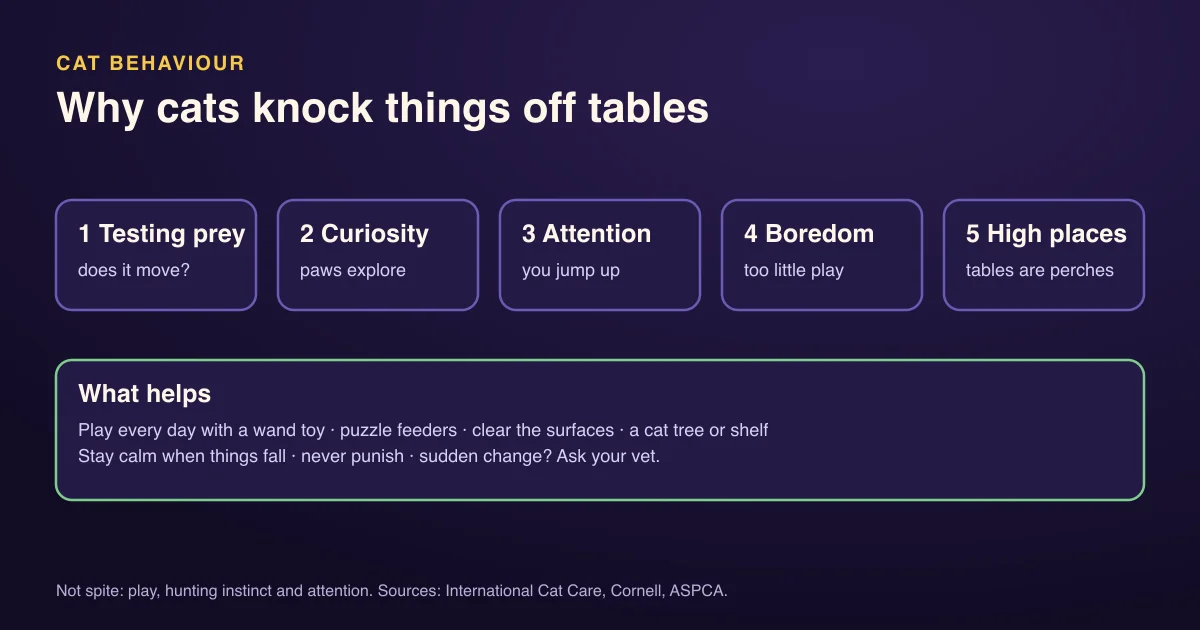
Cats most likely knock things off tables because of play and hunting instinct: a paw tap tests whether an object moves like prey. Curiosity, boredom and the attention it reliably gets from you keep the habit going.
It is not spite. Below are the five usual reasons, what cat-care organisations say about play and boredom, and gentle ways to keep your mugs on the table.
Key takeaways
- A paw tap is part of the hunting sequence: cats check whether something moves before they pounce.
- If knocking things over makes you jump up, your cat learns that it works.
- Bored indoor cats look for their own entertainment, and your table is right there.
- Daily play, puzzle feeders, climbing spots and clear surfaces help. Punishment does not.
- A sudden change in behaviour is worth a word with your vet.
There is no single proven reason
You will find confident answers online, but there is no one study that settles why cats do this. What we do know comes from how cats hunt and play, and from long practical experience at cat-care organisations. The reasons below fit that knowledge, and most cats have more than one of them at once.
1. The hunter is testing “prey”
International Cat Care describes play as a way for cats to act out their whole predatory sequence: “search, stalk, chase, pounce, catch and manipulate.” Batting at a small object is part of that. A bottle cap, a hair tie or an earring is small and light, much like a toy mouse, and a tap answers the hunter’s question: does it move?
If it slides and drops, even better. Watch your cat after the fall: some will peer over the edge, or jump down to bat the object again. That is play, not mischief.
2. Curiosity: paws are for exploring
Cats explore with their paws much as we explore with our hands. A new object on a familiar table is something to investigate: how heavy is it, what sound does it make, what happens when it is pushed? A cat that knocks over only new things is usually just finding out what they are.
3. It gets your attention, so it gets repeated
This is the reason most owners recognise. Your cat taps a glass toward the edge, and you leap up, say its name and come running. From your cat’s point of view, that worked. Behaviour that brings a result tends to be repeated, so a cat that wants breakfast, play or company may learn that knocking something down is the fastest way to get it.
Notice the timing. If it happens mostly at mealtimes, early in the morning or when you sit down to work, your cat may be asking for something.
4. Boredom: not enough play or enrichment
The Cornell Feline Health Center notes that “boredom may contribute to destructive behavior” and that dedicated play time matters, adding that “time spent actively playing with your cat is best, for both of you.” An indoor cat with little to do will make its own fun, and objects on tables are within easy reach.
If you suspect boredom, our guide to indoor cat enrichment ideas has plenty of low-cost ways to fill a cat’s day.
5. They love high places
Tables, counters and shelves are high, and many cats like to be up high, where they can watch the room. Best Friends Animal Society recommends “upright structures and elevated perches” for indoor cats. A cat that spends a lot of time on your table may simply have nowhere better to perch, and while it is up there, everything nearby is a toy.
How to reduce it, kindly
You will probably never stop it completely, but you can make it much rarer:
- Play every day. Use a wand toy and let your cat stalk, chase and “catch”. International Cat Care notes that cats are “sprinters rather than marathon runners”, so short bursts are fine. Rotate two or three toys so they stay interesting, and never use your hands or feet as toys.
- Let food be a hunt. Puzzle feeders and treat balls give your cat something to bat that is meant to move. Best Friends says foraging toys “help satisfy a cat’s natural instinct to search for food.”
- Clear the surfaces. Put breakables, glasses and anything dangerous away, or in a closed cupboard. It is the quickest fix and protects both your things and your cat’s paws.
- Offer a better perch. A cat tree or a sturdy shelf by a window gives your cat a high place of its own.
- Stay calm when things fall. Pick up the object quietly, without a show. Then give attention when your cat is doing something you like.
- Never punish. Shouting, water sprays or swatting do not teach your cat what to do instead. The ASPCA warns that painful punishment “is not only ineffective for changing cat behavior, it can also trigger pain-induced aggression.”
When to ask your vet
Knocking things over is usually normal. But if it starts suddenly, comes with other changes (restlessness, crying at night, changes in appetite, weight or litter habits), or appears in an older cat, ask your vet. In its advice on older cats, the ASPCA says to report all behaviour changes to your vet, because “many changes in behavior are signs of treatable medical disorders.” This article is general information, not veterinary advice.
For fun: be the bad cat
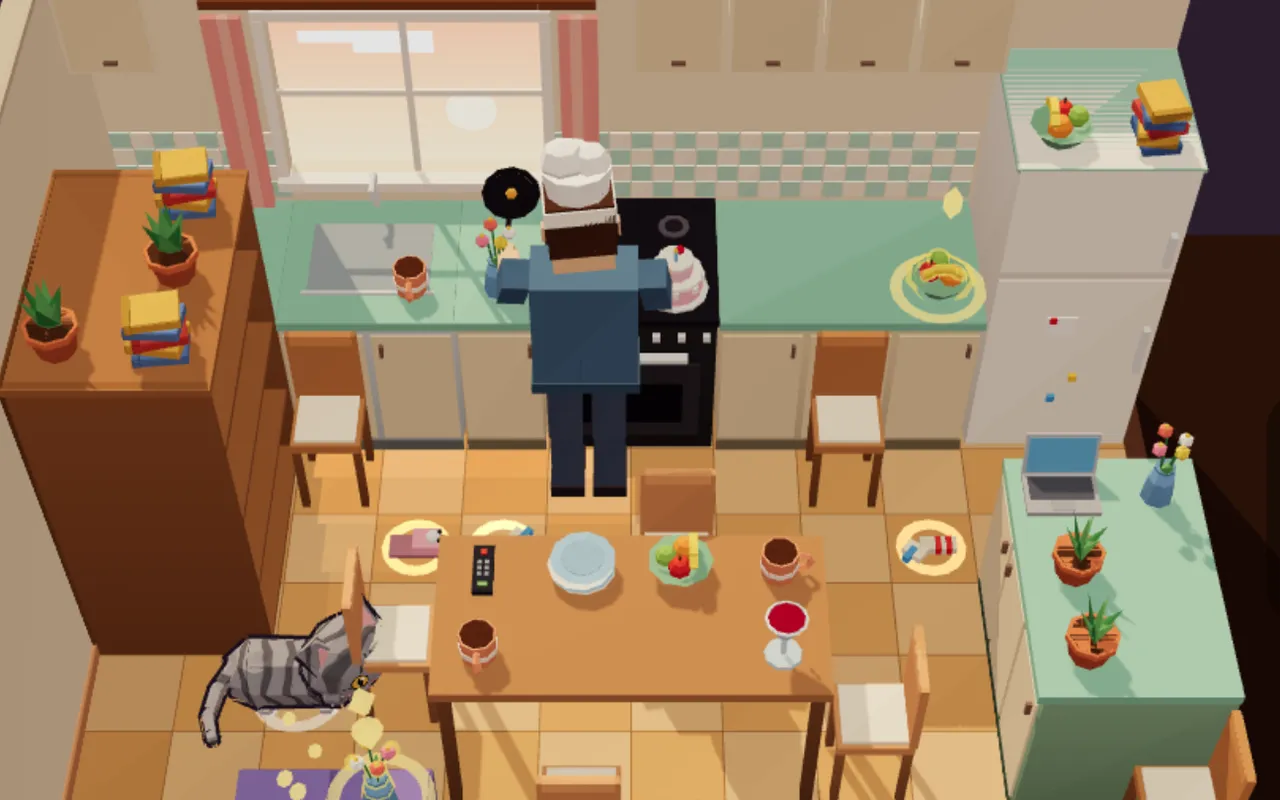
If you have ever wondered what it feels like on the other side of the table, Token Tails made a game for it. In Bad Cat Daily, you are the house cat: you have 75 seconds to knock things off counters, shelves and tables while the human is not looking, and you freeze when they turn around. There is a new room every day, free in the browser. You can even put your own cat in the game from one photo.
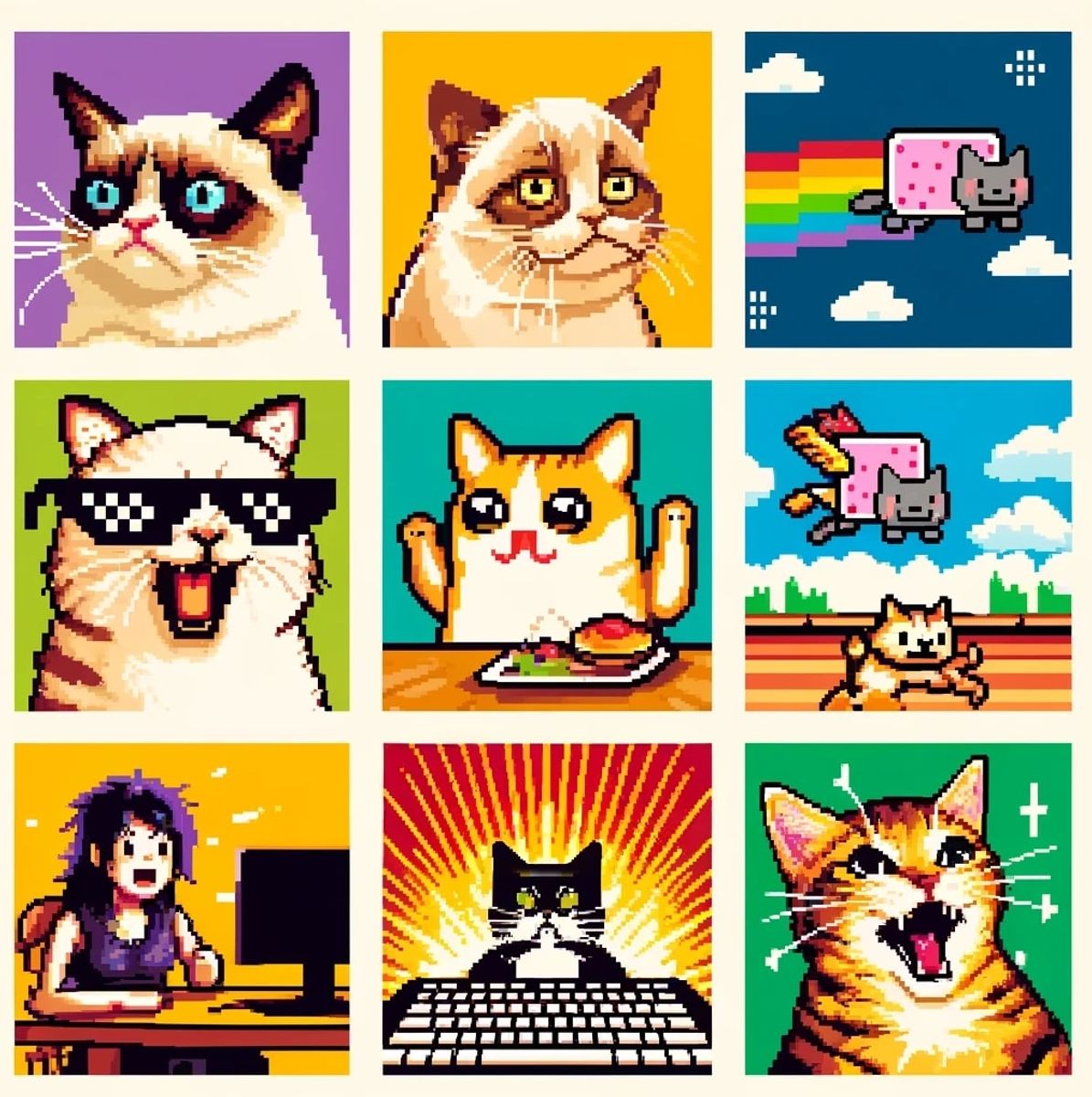
And if your cat’s table habit has made you laugh more than once, you are in good company: our round-up of famous cat memes is full of cats being gloriously themselves.
Frequently asked questions
Is my cat knocking things over out of spite?
No. Cats do not plan revenge. Knocking things down is normal play, exploring and attention-getting behaviour, and it often grows when a cat is bored or has learned that it makes you jump up.
Should I punish my cat for knocking things off the table?
No. Shouting, spraying or swatting does not teach a cat what to do instead and can make it fearful. The ASPCA warns that painful punishment is ineffective and can trigger aggression. Redirect the energy with play and give the cat better places to be.
How do I stop my cat knocking things off the counter?
Clear the surfaces of anything breakable, play with your cat every day, offer puzzle feeders and climbing spots, and stay calm when something falls so the habit does not earn a big reaction.
When should I talk to a vet about it?
If the behaviour starts suddenly, comes with other changes such as restlessness, night-time noise, changes in appetite or litter habits, or appears in an older cat, ask your vet. Some behaviour changes have a medical cause that can be treated.
Check it yourself
Facts checked against live data on . Live figures change: the links below always show the current ones.
- International Cat Care: playing with your cat(opens in a new tab)
- Cornell Feline Health Center: Destructive behavior (PDF)(opens in a new tab)
- ASPCA: aggression in cats (on punishment)(opens in a new tab)
- ASPCA: older cats with behavior problems(opens in a new tab)
- Best Friends Animal Society: cat enrichment(opens in a new tab)
- Every payout for Pink Paw, with its transaction
- Impact: totals with dates and sources
- The open-source payout contracts (MIT)(opens in a new tab)